Best AI Content Detectors for Teachers (Accuracy-First Review)
Teachers don’t need perfect detection. They need reliable signals. This review focuses on which AI detectors come closest to that goal.

John Angelo Yap
Updated February 17, 2026

The new age of AI detection, generated with GPT
Reading Time: 6 minutes
AI detection was supposed to simplify academic integrity.
Instead, it introduced a new problem: false positives.
Teachers are increasingly pressured to rely on AI detectors when evaluating student work. But as I’ve written before, these tools are far from reliable enough to act as judges—especially when false positives can lead to serious academic consequences.
That doesn’t mean detectors have no place in education. It means their role needs to be reframed.
For teachers, the realistic goal isn’t perfect detection. It’s screening: identifying writing that clearly resembles AI output, flagging it for closer review, and then relying on human judgment to make the final call.
This list is accuracy-first and intentionally narrow. Every detector here has been tested in prior articles, and only true-positive performance is considered. No hype, no theoretical claims — just what actually worked.
How this list should be used
Before diving into tools, it’s worth stating this clearly:
No AI detector should ever be used as sole evidence of misconduct.
Detectors are best used to answer one question: “Is this writing sufficiently AI-like that it deserves a closer look?”
That closer look should involve:
- comparing against the student’s prior work
- checking drafting history
- asking follow-up questions
- or using in-class writing samples as reference points
Among the tools tested, Pangram consistently delivered the strongest true-positive performance in our dataset — which is why it leads this list.
Pangram (Our Top Recommendation)
Pangram has emerged as one of the more quietly impressive detectors in recent comparisons.
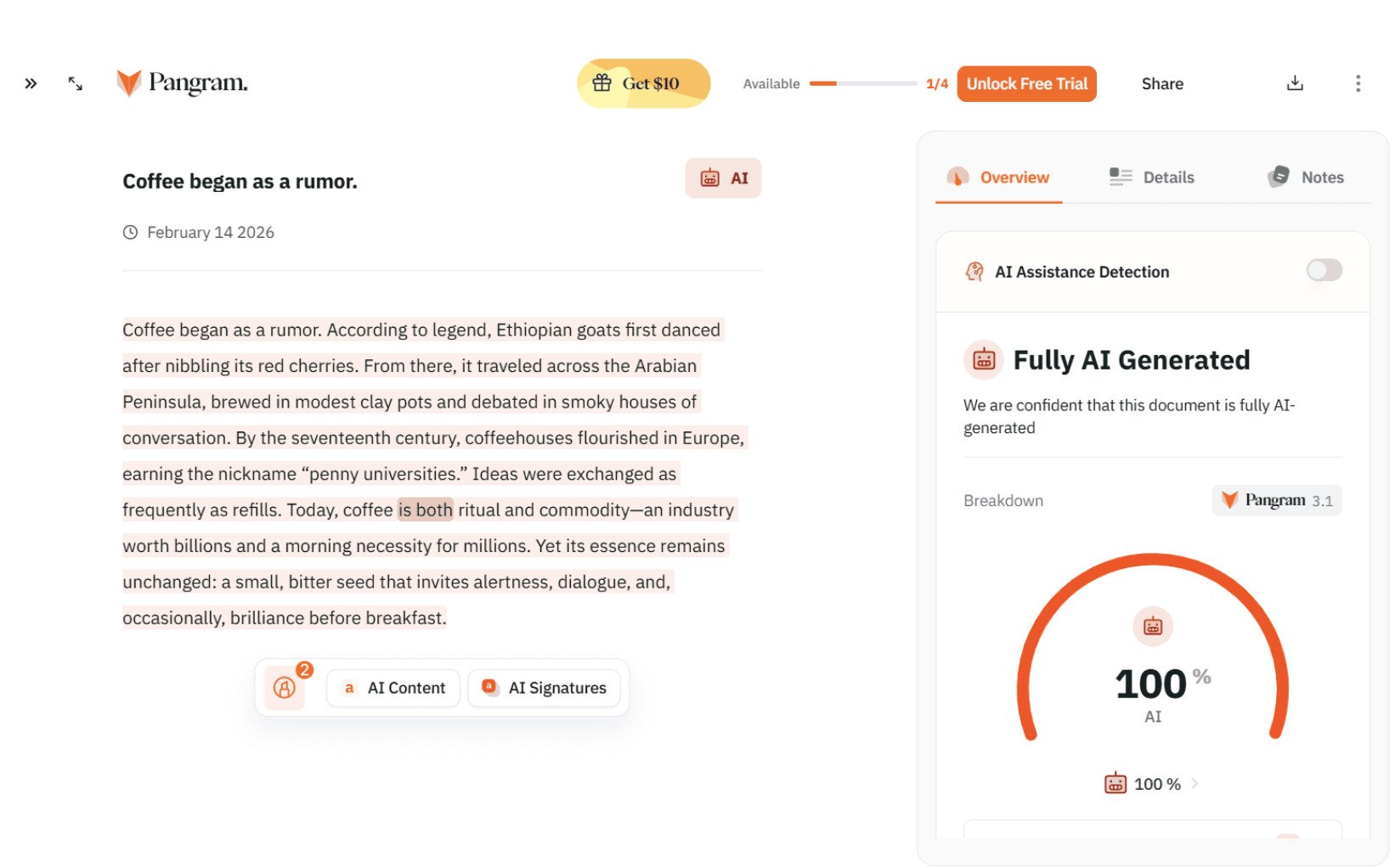
In one of our earlier testing, Pangram managed to detect 100% of the AI-generated test cases, showing unusually strong consistency on clear LLM outputs.
Where Pangram stands out is decisiveness. It tends to be firm when content clearly resembles machine-generated writing, which can be helpful when teachers are dealing with obvious copy-paste AI submissions.
At the same time, decisiveness needs context. Strong detection performance is useful — but only if paired with responsible classroom follow-up.
Does Pangram Actually Work? Additional Testing
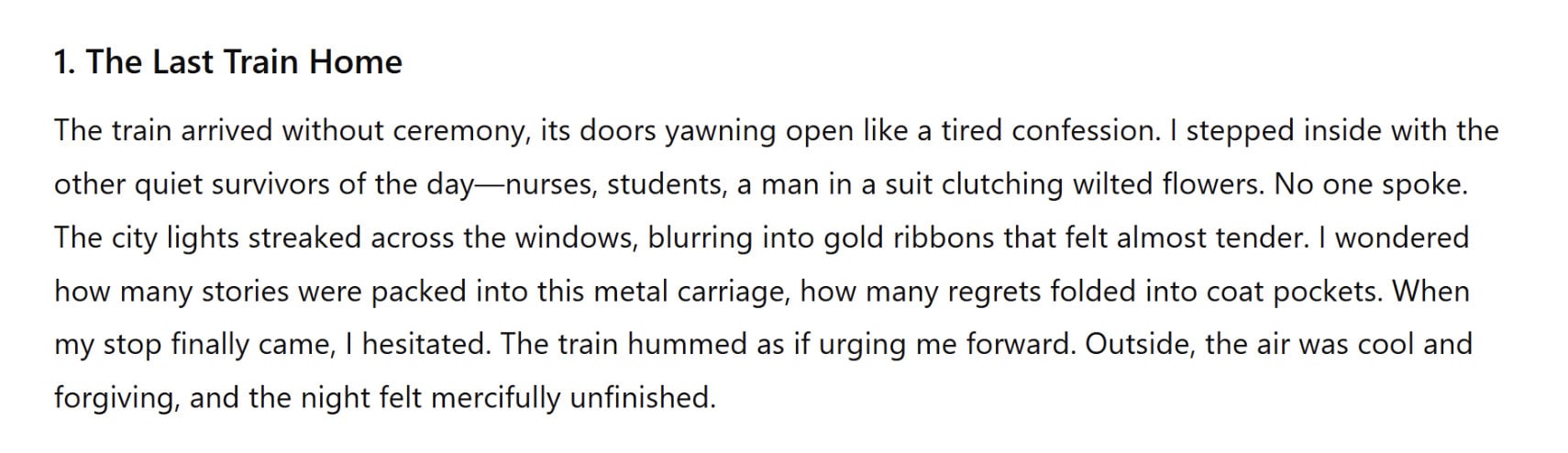
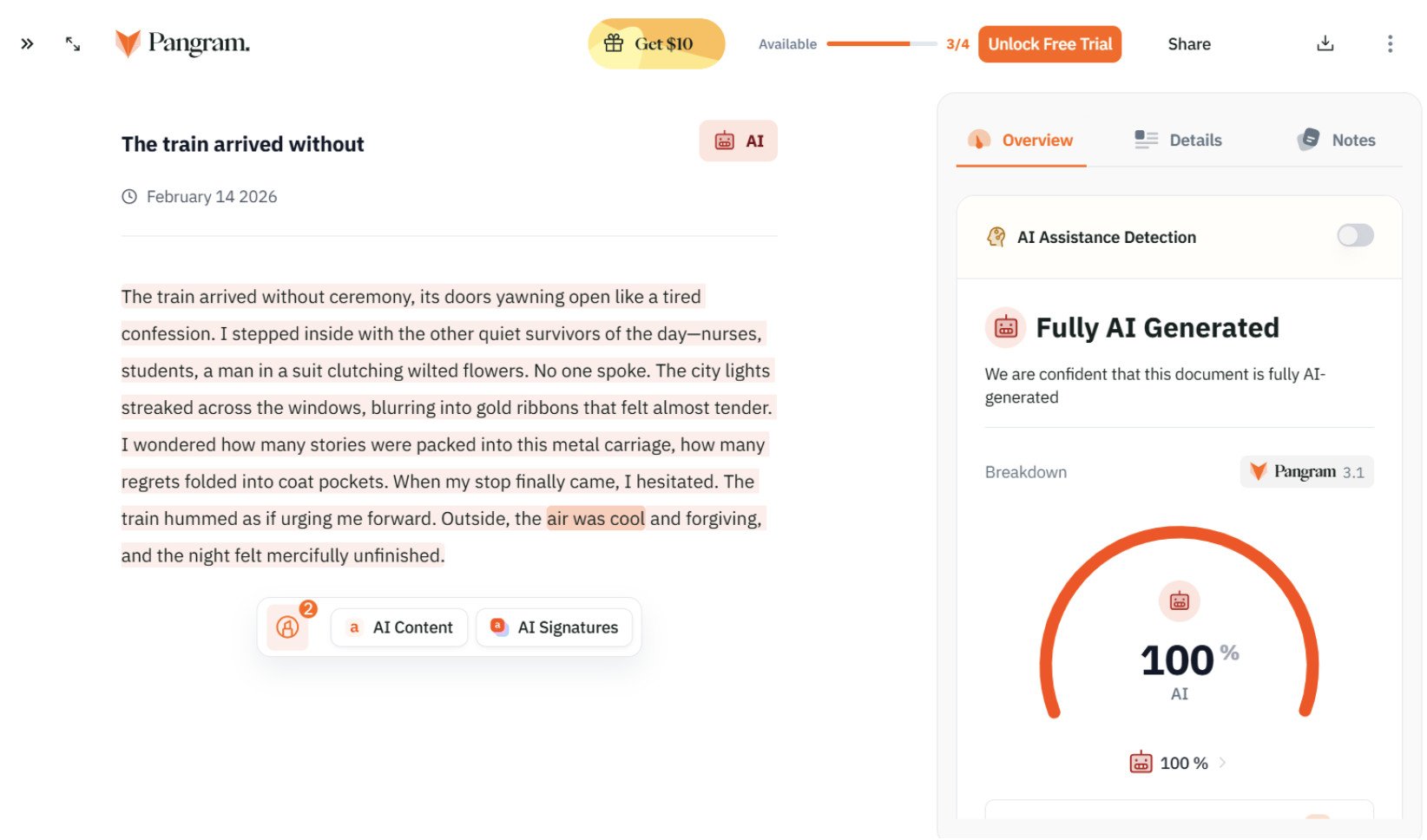
Test #1
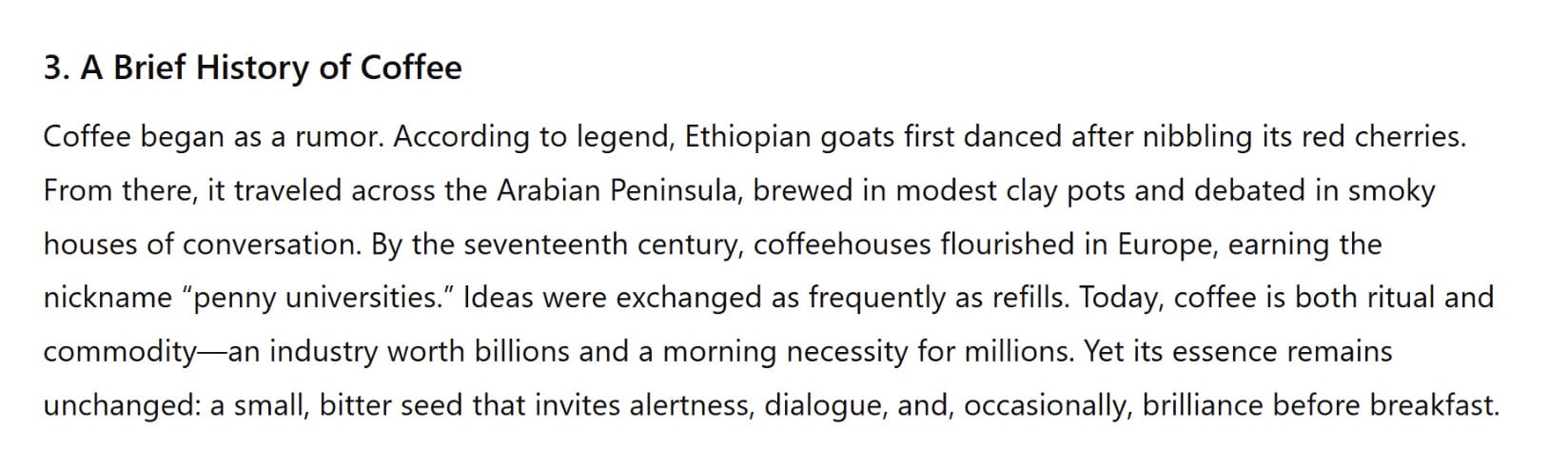
Pangram: Correctly classified text as AI-generated.
AI Likelihood Score: 100%
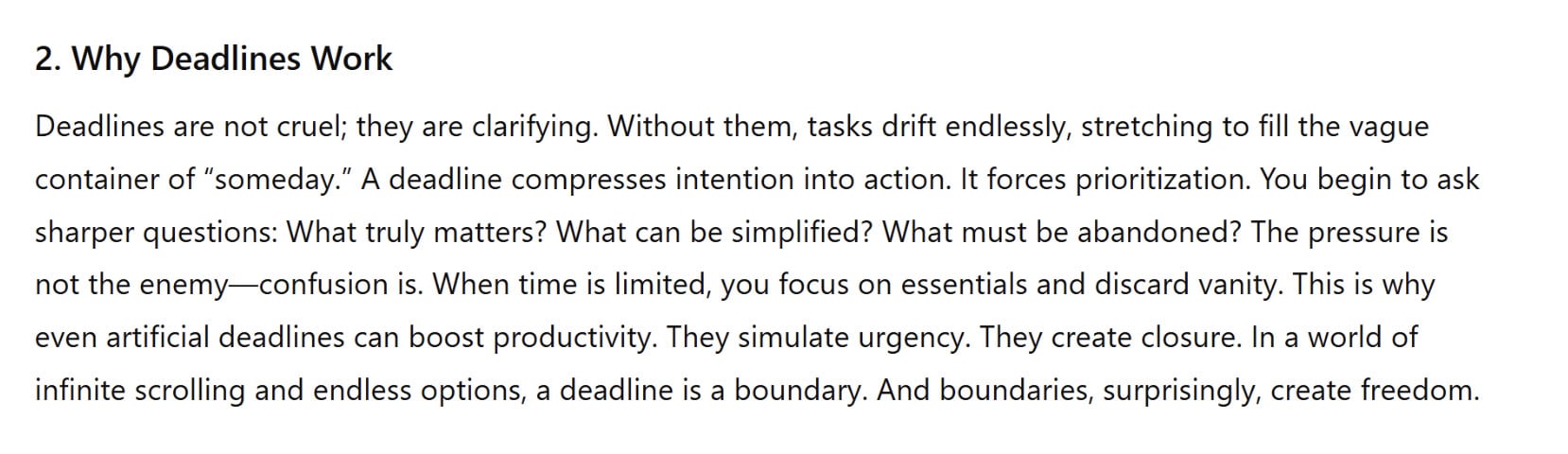
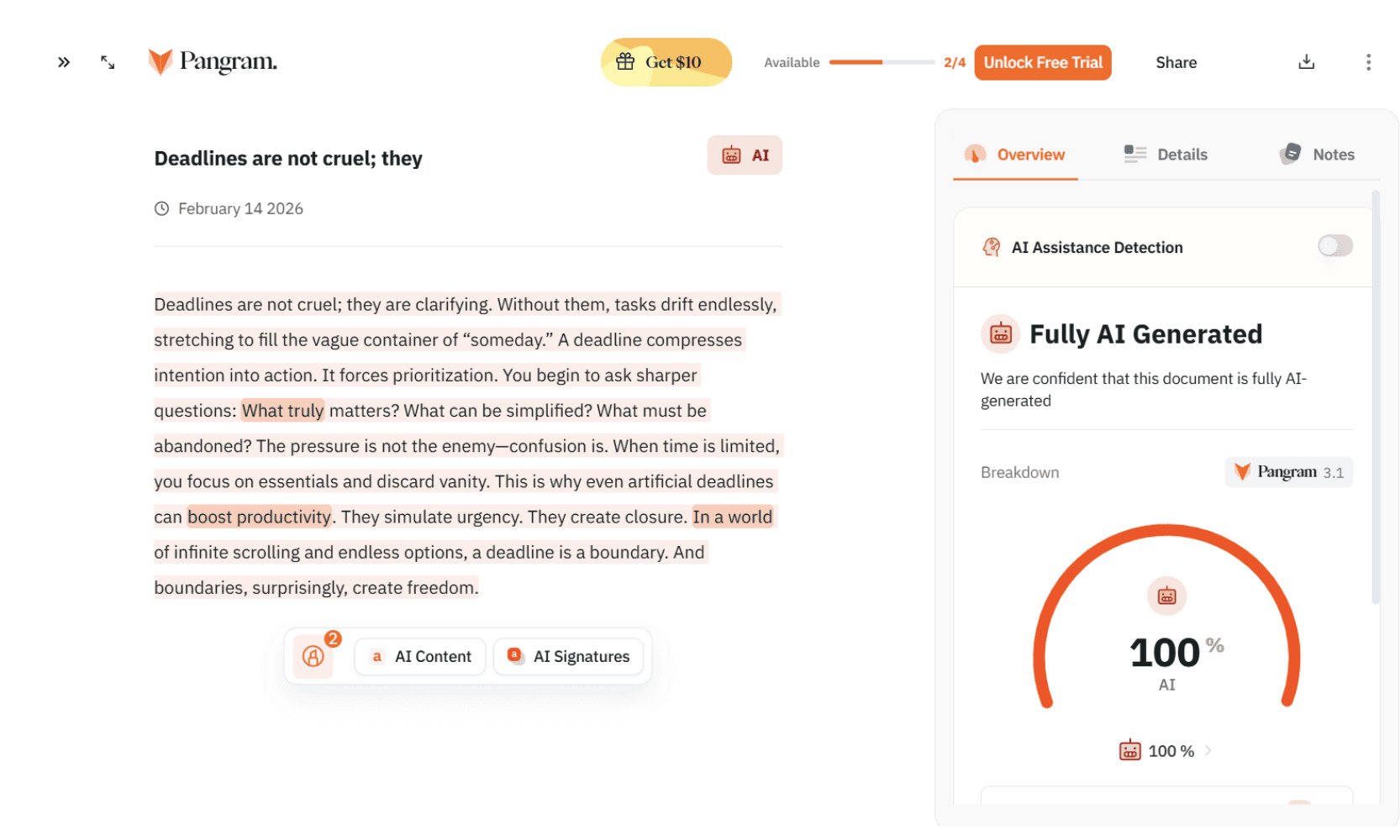
Test #2
Pangram: Correctly classified text as AI-generated.
AI Likelihood Score: 100%
Test #3
Pangram: Correctly classified text as AI-generated.
AI Likelihood Score: 100%
Other Detectors to Consider
In addition to the tools covered above, I also tested a broader set of detectors in the past. That article examined over a dozen detectors across a wide range of models and writing types, and while not all of them make the main recommendations here, a few are still worth knowing about:
Here are other detectors that earned honorable mentions or that you might consider for supplementary checks:
- GPTZero — 65.25% true-positive accuracy in the final tally. It’s not a top performer in that dataset, but it’s still a widely used classroom cross-check—best treated as a secondary signal, not a deciding factor.
- Originality.ai — 68.83% true-positive accuracy in the final tally. Useful if you want a stricter detector with a publishing-style workflow, but its core detection performance lands mid-pack here.
- Content at Scale (now, BrandWell) — 70.83% true-positive accuracy in the final tally. It performed better than the weakest tools, but still doesn’t beat the top classroom-safe defaults.
Sapling
Sapling is another consistent detector I’ve tested for identifying plain, unedited AI writing.
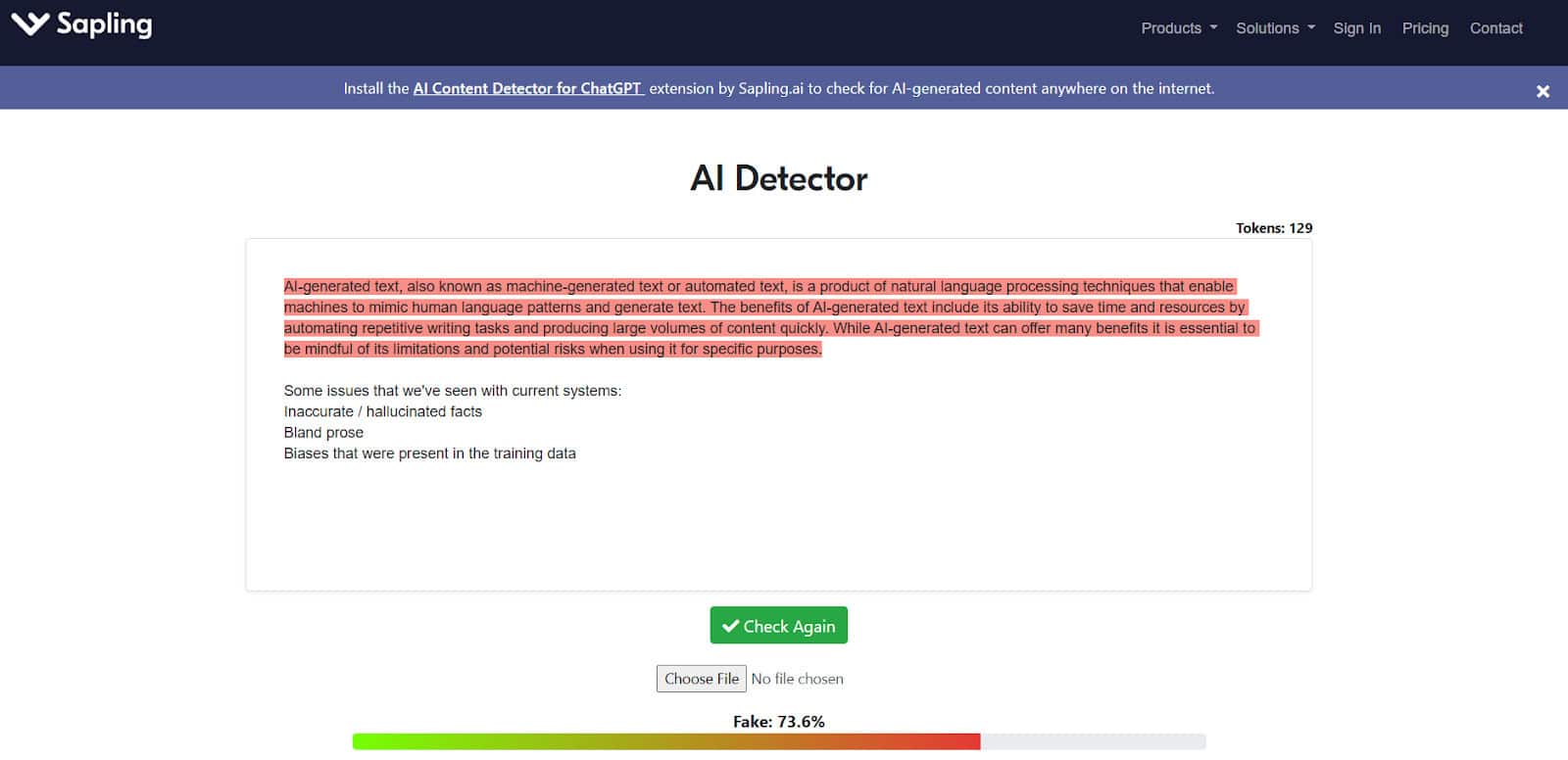
In controlled testing, Sapling correctly identified 100% of baseline ChatGPT outputs, with an overall true-positive accuracy score of 67.92% across broader samples that includes Undetectable AI output (an AI humanizer).
What makes Sapling especially suitable for classrooms is restraint. It doesn’t attempt to over-explain results or inflate confidence. You get a clear signal, not a theatrical verdict.
That matters. Teachers don’t need dramatic percentages — they need predictability. Sapling’s behavior is consistent enough that, when it flags something strongly, it’s usually worth a second look.
Sapling is also largely free, which removes a major barrier for institutional or personal use.
If you only use one detector, this is the safest default.
Winston AI
Winston AI is a more feature-heavy detector, and its accuracy reflects that ambition.
In testing, Winston successfully detected 100% of straightforward AI-generated text, performing very well on unmodified LLM outputs, but only 50% for Undetectable AI outputs.
Where Winston becomes less predictable is with mixed or lightly edited content — not because it fails entirely, but because its confidence can vary significantly depending on structure and length.
For teachers, Winston works best as a secondary validator, especially when documentation or reporting is required. It’s not free (which is why this is not as strong as a recommendation as Sapling) but it’s robust, and its detection strength on obvious AI content is strong.
Copyleaks
Copyleaks is often positioned as an institutional tool, and its testing results justify that reputation — with caveats.
In prior testing, Copyleaks achieved a 78.27% true-positive accuracy score.
Its strength lies in consistency across environments, especially when paired with plagiarism detection. However, its interface and licensing model make it better suited for school-wide adoption rather than individual teacher use.
Copyleaks is not fully free, but many institutions already have access. This is great if only you either have extra cash to spend or your school can give you one.
TruthScan
In targeted testing focused on Gemini outputs, TruthScan achieved a 93% true-positive accuracy score, outperforming many general-purpose detectors in that scenario.
For classrooms encountering newer LLM writing styles that don’t necessarily resemble classic ChatGPT output, TruthScan can be a valuable addition. This is especially true since TruthScan is entirely free and also works with AI image detection — making it a truly great platform overall.
My Final Thoughts
Pangram has quickly become one of the more compelling options — especially if its detection strength holds up under continued testing. Its decisiveness on clear AI outputs makes it worth serious consideration in classroom environments. It's honestly the one I'm most excited about in terms of growth as a platform and overall consistency.
Sapling is also another safe starting point. It’s free, consistent, and strict enough to catch obvious AI writing without encouraging overconfidence.
And regardless of tool, remember this:
AI detectors should guide attention, not determine guilt. Used carefully, they can help teachers navigate a difficult transition. Used carelessly, they risk undermining trust — exactly the outcome they were meant to prevent.
Want to Learn Even More?
If you enjoyed this article, subscribe to our free newsletter where we share tips & tricks on how to use tech & AI to grow and optimize your business, career, and life.