Which One Can Spot a Deepfake? ImageDetector or DFDetect
We put Jalen Brunson in a Celtics jersey to see which AI image detector would catch the obvious fake. One tool flagged it instantly. The other called it real, and its not who you would expect.

Mark Gotauco
Updated June 18, 2026
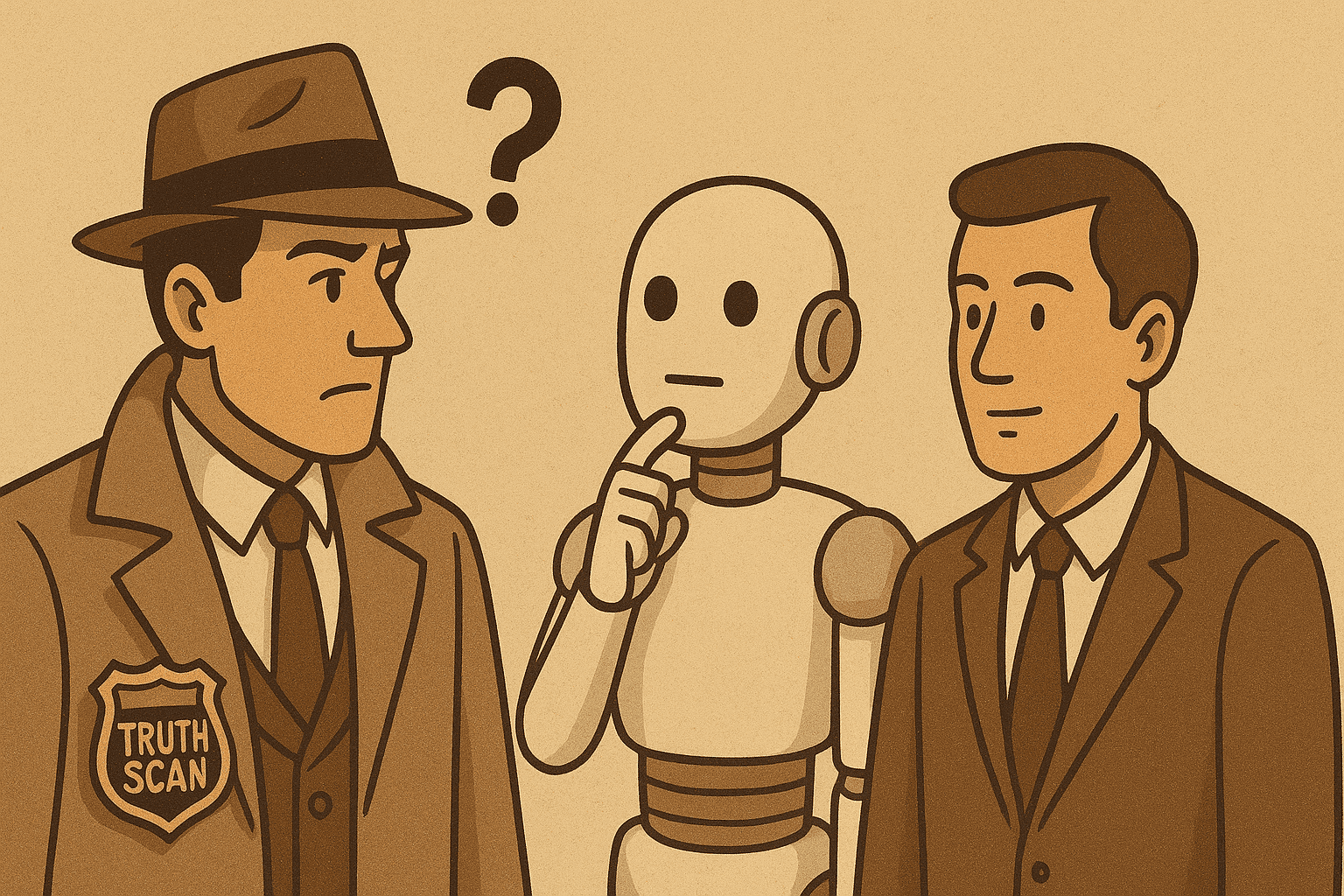
A detective trying to figure out which is robot and human, generated with GPT-4
Reading Time: 6 minutes
In 2023, a deepfake photo of an explosion near the Pentagon spread across Twitter and briefly triggered a dip in the stock market.
The image was AI-generated. It took minutes to go viral and hours to fully debunk.
That was 2023. Before Midjourney v6. Before ChatGPT could generate photorealistic portraits with readable text baked in. Before the tools to create convincing synthetic images became free, fast, and available to anyone with a browser.
A 2024 Deloitte Connected Consumer survey found that 68% of respondents familiar with generative AI worry about synthetic content being used to scam or deceive them.
And 59% say they already struggle to tell AI-generated media from the real thing.
That gap is exactly what deepfake detectors are supposed to close. Whether they actually do is a different question.
ImageDetector and DFDetect are two of the more actively used tools in this space. They approach the problem from very different angles, so we ran both through six tests.
Here's what happened.
What is ImageDetector?
ImageDetector is a free, browser-based AI image checker built for non-technical users who need a fast, no-friction answer to a simple question: is this image real or AI-generated?

It covers outputs from the major generators including Midjourney, DALL·E, Gemini, Stable Diffusion, Flux, Ideogram, GANs, and Bing Image Creator.
The detection method works directly on the image itself, analyzing texture patterns, noise behavior, and structural details that differ between AI-generated and human-captured images.
It doesn't rely on metadata or watermarks, which matters because both are trivially easy to strip or never embedded in the first place.
For pricing, it is fully free; there is an enterprise tier mentioned on the site for high-volume and automated use cases, but no pricing is listed publicly.
You'd need to contact them directly.
What is DFDetect?
DFDetect is a different kind of tool entirely. Where ImageDetector reads like a consumer product, DFDetect reads like a research model card, and that distinction matters for understanding what you're actually getting.

Under the hood, it uses an EfficientNet-based deep learning architecture trained on more than 134,000 videos across roughly 1,140 identities and 20 different synthesis methods.
On paper, the benchmark numbers are strong: 96.36% accuracy, 94.95% precision, and 97.94% recall, outperforming baseline models like XceptionNet and MesoNet on standard deepfake datasets.
DFDetect is also narrower in scope by design. Its core output is a per-face authenticity score, evaluating individual faces within an image rather than the image as a whole.
For images without faces, or where AI generation is in the background rather than the subject, it may not give you much to work with.
For pricing, it's also a Free tool similar to ImageDetector key difference is a 2MB file upload limit per image.
A Quick Note on Privacy
Both tools process uploaded images on their servers. Don't upload anything sensitive, personally identifiable, or anything you wouldn't want passing through a third-party platform.
ImageDetector states that images are stored in accordance with their privacy policy, but the site doesn't explicitly confirm whether uploaded images are retained or used for model training.
DFDetect processes files in memory and purges them shortly after the verdict is returned, with no indication of long-term storage.
Neither tool makes guarantees that should make you comfortable uploading, say, someone else's ID or a private document. Treat both as you would any cloud-based analysis service.
The Test Setup
We ran six tests designed to reflect the scenarios these tools are most likely to encounter in real-world use.
Test 1: AI-generated image from ChatGPT
Test 2: AI-generated image from Gemini
Test 3: AI-generated image from Midjourney
Test 4: A real photograph taken on a standard camera with no edits
Test 5: An edited photo with AI-assisted enhancements applied
Test 6: An image pulled directly from a social media post
ImageDetector vs. DFDetect: AI Image Detection Results
Test 1: ChatGPT-Generated Image
ImageDetector: Correctly flagged the Image as AI Generated
AI Likelihood Score: 99%

DFDetect: Incorrectly identified the Image as Human
AI Likelihood Score: 0.25%

Test 2: Gemini-Generated Image
ImageDetector: Correctly flagged the Image as AI Generated
AI Likelihood Score: 99%

DFDetect: Incorrectly identified the Image as Human
AI Likelihood Score: 0%

Test 3: Midjourney-Generated Image
ImageDetector: Correctly flagged the Image as AI Generated
AI Likelihood Score: 99%

DFDetect:Incorrectly identified the Image as Human
AI Likelihood Score: 0.31%

Test 4: Real Photograph
ImageDetector: Correctly identified the Image as Real
AI Likelihood Score: 4%

DFDetect: Correctly identified the Image as Real
AI Likelihood Score: 17.33%

Test 5: Edited Photo
ImageDetector: Correctly identified the Image as Real
AI Likelihood Score: 3%

DFDetect: Correctly identified the Image as Real
AI Likelihood Score: Did not give out a Score

Test 6: Social Media Image
ImageDetector: Correctly identified the Image as Real
AI Likelihood Score: 6%

DFDetect: Correctly identified the Image as Real
AI Likelihood Score: 0%

Results Summary
| Test | ImageDetector | DFDetect |
| #1 ChatGPT Image | 99% | 0.25% |
| #2 Gemini Image | 99% | 0% |
| #3 Midjourney Image | 99% | 0.31% |
| #4 Real Photo | 4% | 17.33% |
| #5 Edited Photo | 3% | N/A |
| #6 Social Media Image | 6% | 0% |
| Correct Verdicts | 6/6 | 3/6 |
My Final Thoughts
Let's start with what DFDetect actually did in this test, because it tells you almost everything you need to know about where the tool fits and where it doesn't.
One of our AI-generated images was a ChatGPT-produced photo of Jalen Brunson, the Knicks' star, dressed in a Celtics uniform.
The kind of image that would send any basketball fan's blood pressure up, and exactly the kind of synthetic content that circulates on social media to mislead, provoke, or deceive. DFDetect looked at that image and returned a 0.25% AI likelihood score.
Effectively zero. It called it real. It did the same for the Gemini image. And the Midjourney image.
That's not a mistake. That's the tool doing exactly what it was built to do and still getting it completely wrong in a real-world scenario.
ImageDetector went six for six. It caught all three AI-generated images at 99%, held steady on the real photograph at 4%, correctly read the edited photo at 3%, and cleared the social media image at 6%.
The scores are consistent in both directions, high confidence on synthetic content, low and stable on real content.
That's exactly the behavior you want from a detection tool.
The honest caveat is that six images isn't a large sample, and no single tool should be the last word on whether an image is real. But if you're trying to catch AI-generated photos, particularly the kind being used to spread misinformation or manipulate sports fans and news readers,
ImageDetector is the one actually doing that job.
For an Undetectable AI-specific image detector matchup, read our Undetectable AI vs WasItAI test.
Want to Learn Even More?
If you enjoyed this article, subscribe to our free newsletter where we share tips & tricks on how to use tech & AI to grow and optimize your business, career, and life.