Proofig or TruthScan? Which Should You Use?
Proofig is built for Science, while TruthScan is built for everything. The only question is: what should you actually reach for?

John Angelo Yap
Updated January 10, 2026
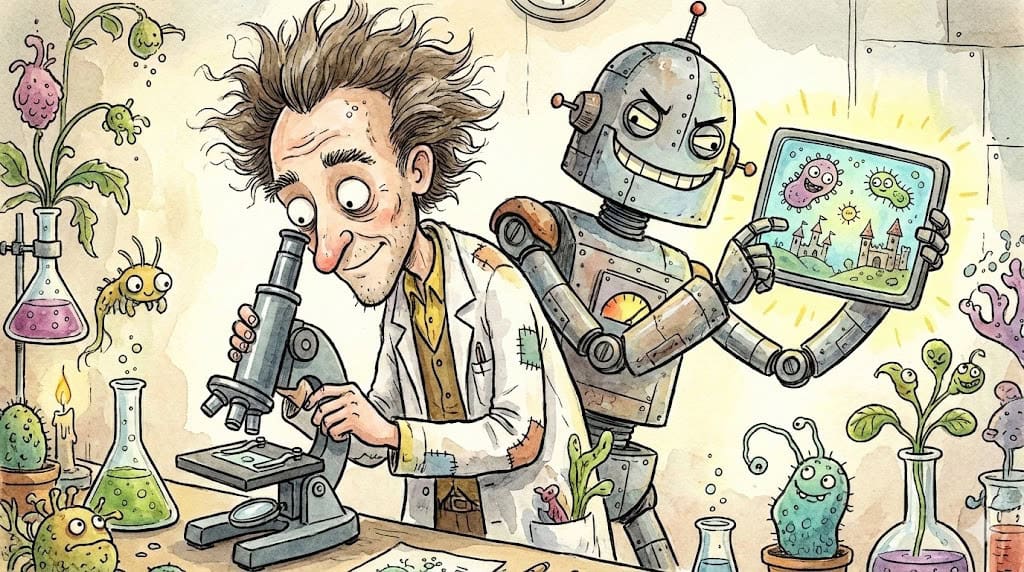
A scientist getting fooled by an AI, generated with Gemini
Reading Time: 5 minutes
Not all AI image detectors are built for the same job — and Proofig is probably the clearest example of that.
When people talk about “AI image detection,” they often lump everything into one bucket. Can this tool tell if an image is fake or real? Can it spot AI-generated visuals? Can it catch manipulation? But once you look closer, you realize there are very different kinds of image integrity problems, and different tools are optimized for very different environments.
That’s why this comparison is a little unusual. I wasn’t able to directly test Proofig in the same way I test most AI image detectors — not because it’s inaccessible, but because it’s not designed for casual uploads, social media images, or general AI-generated visuals. Proofig is purpose-built for scientific publishing, and it shows.
So instead of a head-to-head test, this article looks at what each tool is actually designed to do, where they overlap, and why both can be considered excellent — just in very different lanes.
What is Proofig?
Proofig is an AI-powered image integrity platform built specifically for the scientific and academic community.

It’s used by researchers, publishers, and institutions that need to ensure the authenticity of figures inside scientific papers — things like microscopy images, western blots, histology slides, and other research visuals where even subtle manipulation can undermine an entire study.
At its core, Proofig isn’t trying to answer “Is this image AI-generated?” in the general sense. It’s trying to answer a much more precise question: “Has this scientific image been altered, duplicated, reused, or fabricated in a way that violates research integrity?”
And that distinction matters.
What Proofig Actually Does
Proofig’s strength lies in how deep it goes into scientific image analysis. Rather than just classifying an image as “AI” or “not AI,” it breaks integrity issues into very specific categories.
Image Manipulation Detection
Proofig can detect alterations within a single sub-image, including:
- Cloning
- Editing
- Deletion
- Splicing
This is especially important for scientific figures, where even minor edits — like removing a blemish from a blot or copying a region — can misrepresent results.
Duplication & Reuse Analysis
One of Proofig’s standout features is its ability to detect duplicated images within a manuscript, even if they’ve been:
- Scaled
- Rotated
- Flipped
- Partially overlapped
This catches both accidental reuse and intentional duplication across figures — something general AI detectors aren’t built to do.
AI-Generated Image Identification (Scientific Context)
Proofig can identify AI-generated images, but specifically in scientific domains. This includes detecting fabricated or synthetic microscopy images and other research visuals generated by popular models, with continuous updates as new models emerge.
Image Plagiarism Checker
Proofig compares submitted images against massive databases — including PubMed sources containing tens of millions of scientific images — to detect reused visuals across published manuscripts.
This goes far beyond basic duplication checks and into full-scale image plagiarism detection.
Self-Plagiarism Control
Through a personalized researcher database, Proofig can detect when authors reuse their own previously published images without proper disclosure — something journals take very seriously.
What is TruthScan?
TruthScan comes from a very different angle.

Rather than focusing narrowly on scientific publishing, TruthScan is built as a comprehensive AI detection suite. Its goal is to help organizations, platforms, and individuals determine whether content — text, images, audio, or video — is AI-generated or manipulated.
For the purpose of this article, we’re focusing on TruthScan’s AI image detection, but it’s worth noting that this is just one piece of a much larger ecosystem.
TruthScan offers:
- AI image detection for general visuals
- AI text detection
- Deepfake video detection
- AI voice detection
- Real-time monitoring and alerts
- API-based deployment for enterprise use
In other words, TruthScan is designed for environments where AI-generated content shows up everywhere, not just inside research papers.
Where Proofig and TruthScan Overlap, and Where They Don't
PROOFIG is built for science, like images that are: | TRUTHSCAN is built for everything, like images that are: |
|
|
Proofig vs. TruthScan’s Pricing
This is where the difference between Proofig and TruthScan becomes impossible to ignore.
TruthScan’s AI image detector is free to use, which immediately lowers the barrier for anyone who just wants to check whether an image might be AI-generated or manipulated. There’s no credit system to think about, no tiers to decode, and no “contact sales” wall before you can even try the tool. You upload an image, get a result, and move on.

Proofig, by contrast, is priced exactly like what it is: a specialized, enterprise-grade scientific integrity platform.
For individual researchers and principal investigators, Proofig offers annual plans based on sub-images analyzed:

- 120 sub-images — $99/year
- 320 sub-images — $230/year
- 620 sub-images — $400/year
- 1,020 sub-images — $610/year
And that’s just the individual tier. Multi-user and enterprise plans require direct contact with Proofig for custom pricing, which makes sense given their audience — ethics boards, publishers, and academic institutions handling large volumes of manuscripts.
So, Which Should You Use?
Once you factor in pricing, the picture becomes even clearer.
TruthScan stands out as an incredibly accessible option for AI image detection. Being free removes friction entirely, making it easy for individuals, teams, and organizations to quickly assess image authenticity in everyday contexts.
Proofig, on the other hand, earns its price by doing something very few tools even attempt. It doesn’t just flag images — it analyzes scientific figures at a granular level, detects duplication and manipulation across manuscripts, and protects research integrity in ways general-purpose detectors simply aren’t designed to handle.
For researchers and publishers, that depth justifies the cost.
So this isn’t really about which tool is “better.” It’s about what problem you’re solving.
Want to Learn Even More?
If you enjoyed this article, subscribe to our free newsletter where we share tips & tricks on how to use tech & AI to grow and optimize your business, career, and life.