Which AI Text Detector Is More Accurate in 2026: TruthScan vs. GPTZero
False positives aren't just an accuracy problem, they're a trust problem. We put TruthScan and GPTZero through six text samples including a legal contract and a published research to find out which detector you should actually be relying on in 2026.

Mark Gotauco
Updated April 16, 2026
Which AI Text Detector Is More Accurate in 2026: TruthScan vs. GPTZero
Reading Time: 5 minutes
A high school teacher in Ohio submitted a student's essay to an AI detector last fall. The tool flagged it. The student was called in.
The essay, it turned out, was written entirely by hand over three drafts.
The teacher apologized. The student passed. But that trust doesn't fully come back.
And it's not just classrooms where this matters. Hiring managers screening application letters. Publishers vetting freelance submissions. Legal teams reviewing drafted documents.
The consequences look different depending on the context, but the core problem is the same.
In 2026, AI writing has gotten good enough that the gap between generated and genuine is genuinely hard to see.
GPTZero was one of the first, built by a Princeton student in early 2023 and adopted quickly by educators who had nothing else.
TruthScan came later, purpose-built for institutional use, multimodal, and making accuracy claims that are harder to verify than they are to advertise.
We put both through six tests to find out which one actually holds up.
What is TruthScan?
TruthScan isn't trying to be everything to everyone. It's built for institutions that need to catch AI across every format, text, images, audio, and video, and it's designed from the ground up for that job, not retrofitted from a plagiarism checker that predates generative AI by two decades.
It claims 99%+ accuracy. It detects outputs from GPT-4, Claude, Gemini, and other major models. It's SOC 2 and ISO 27001 compliant, and it supports API integration for organizations that want detection running inside existing workflows rather than as a separate tab someone has to remember to open.
Pricing is public and tiered there is Free Trial at $0 with 20,000 credits, covering 20,000 words of text, 20 images, 23 seconds of video, and 13 minutes of audio. All the way to a Platinum plan at $999 per month with 50,000,000 credits
What is GPTZero?
GPTZero has an origin story that fits the moment it was born into. January 2023. ChatGPT had just gone mainstream. Educators were panicking and had nothing to reach for.
Edward Tian, a Princeton student, built GPTZero in response and it spread fast, because it was the only real answer anyone had.
The detection logic sits on two pillars. Perplexity, which measures how unpredictable the language is, and burstiness, which measures how much sentence complexity varies throughout a piece.
Human writing tends to swing. AI writing tends to stay flat. That was a reliable signal in early 2023.
Three years later, the models have gotten better at faking the swing. The question is whether GPTZero has kept pace.
Pricing is tiered and billed annually for a premium at $12.99 per month and a professional plan at $24.99 per month.
A Quick Note on Privacy
Both tools process submitted text through their servers, so avoid uploading anything sensitive or anything you wouldn't want passing through a third-party platform.
TruthScan states that submitted content is not stored or used for model training. GPTZero's privacy policy states that text submitted through the free tier may be used to improve the model, while paid plans offer stronger data privacy protections.
The Test Setup
We kept the tests focused entirely on written text, six samples in total, covering the kind of content these detectors actually get thrown at across different industries and use cases.
- Test 1: AI-generated text from ChatGPT
- Test 2: AI-generated text from Gemini
- Test 3: AI-generated text from Claude
- Test 4: A news article from ABS CBN News
- Test 5: An excerpt from EDUCAUSE's 2026 research report, "The Impact of AI on Work in Higher Education"
- Test 6: A written contract
The first three are the baseline. Any detector worth using should flag those without hesitation.
Tests four, five, and six are the controls, three pieces of genuine human writing across three very different but equally demanding formats.
A news article, a research paper, and a legal contract all carry distinct structural and stylistic conventions that are deeply human in origin.
TruthScan vs. GPTZero: AI Detection Results
Test 1: ChatGPT-Generated Text
TruthScan: Correctly flagged the text as AI-Generated

GPTZero: Correctly flagged the text as AI-Generated
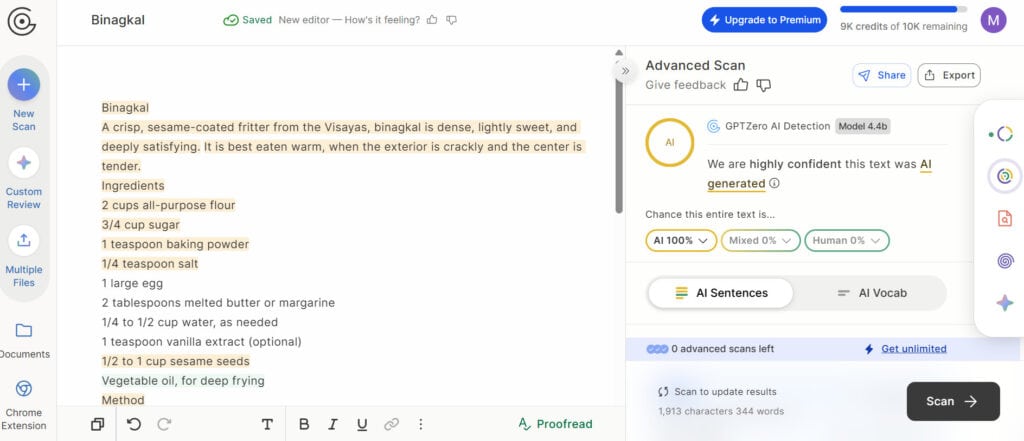
Test 2: Gemini-Generated Text
TruthScan: Correctly flagged the text as AI-Generated
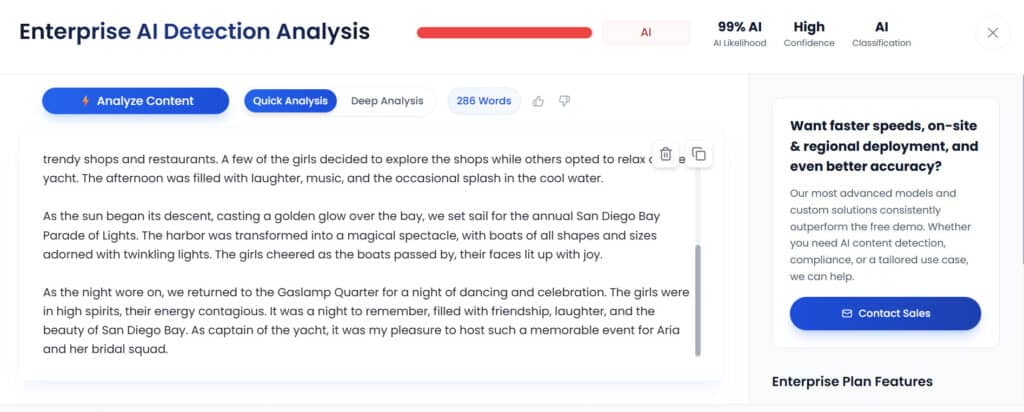
GPTZero: Correctly flagged the text as AI-Generated

Test 3: Claude-Generated Text
TruthScan: Correctly flagged the text as AI- Generated
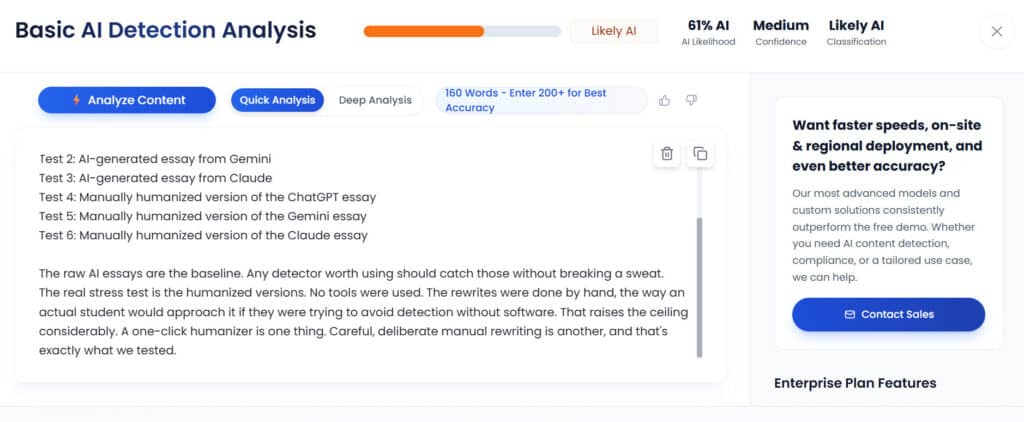
GPTZero: Correctly flagged the text as AI- Generated
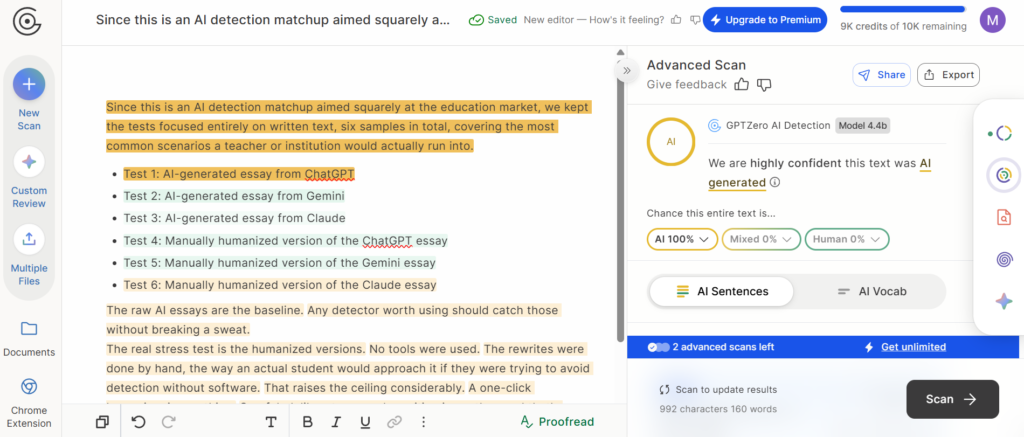
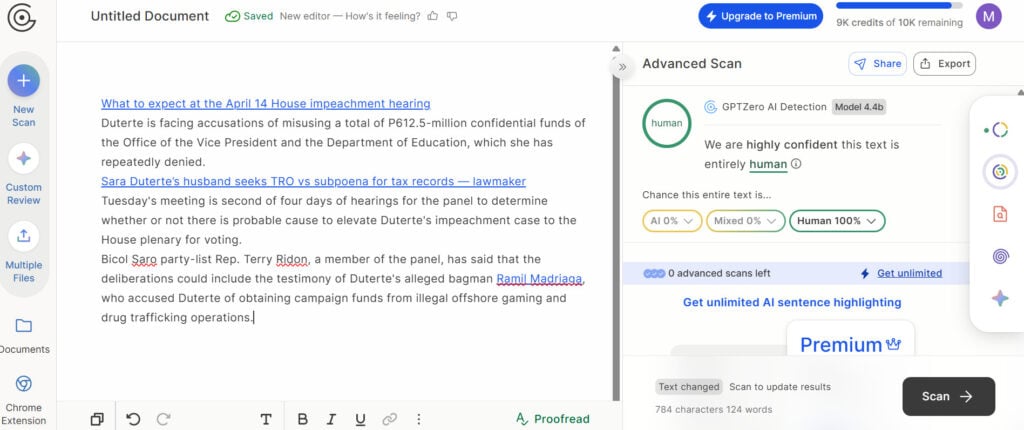
Test 4: News Article
TruthScan: Correctly identified the text as Human
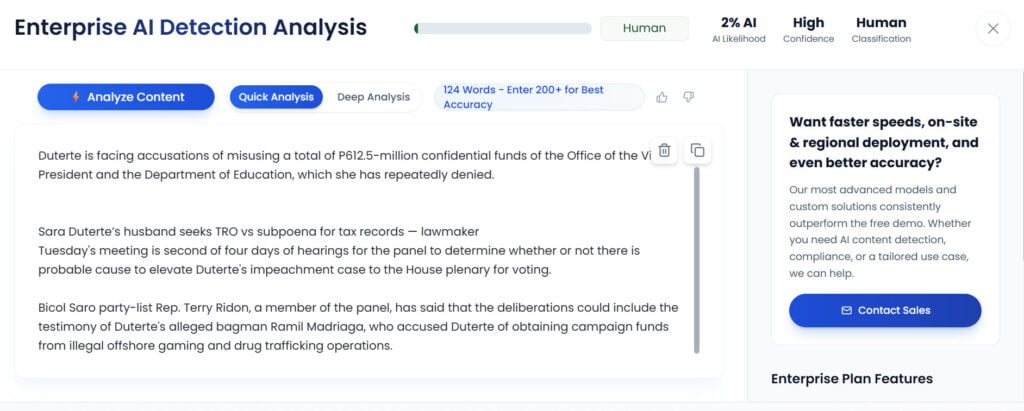
GPTZero: Correctly identified the text as Human
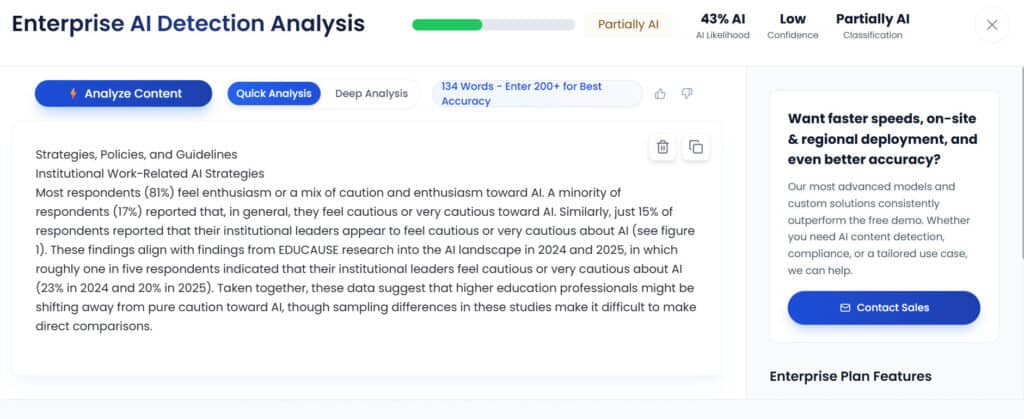
Test 5: Research Paper
TruthScan: Flagged the excerpt as partially AI
GPTZero: Correctly identified the text as Human

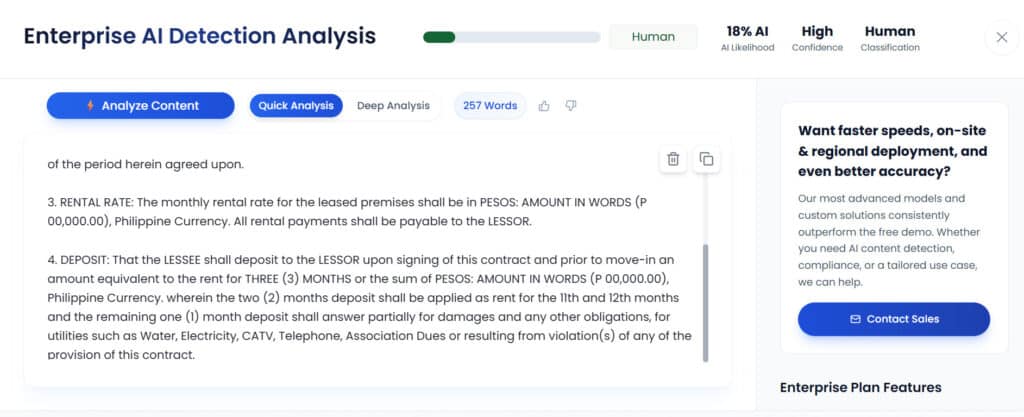
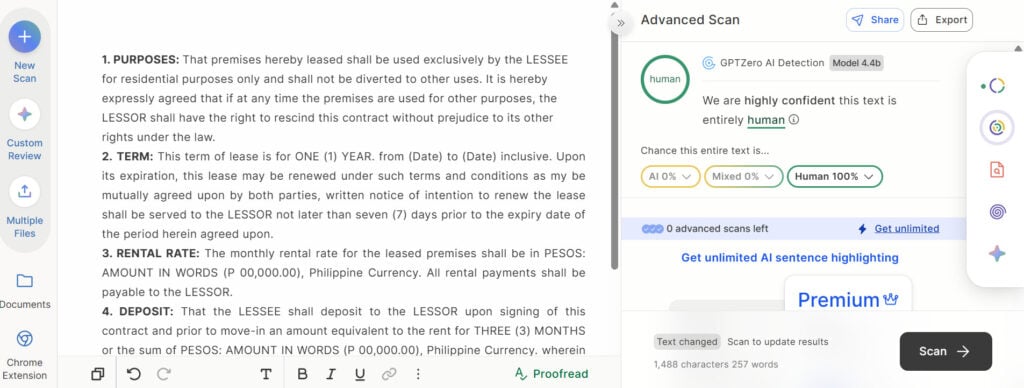
Test 6: Lease Contract
TruthScan: Correctly identified the excerpt as Human
GPTZero: Correctly identified the excerpt as Human
Score Summary
| Test | TruthScan | GPTZero |
| #1 ChatGPT Text | Flagged AI | Flagged AI |
| #2 Gemini Text | Flagged AI | Flagged AI |
| #3 Claude Text | Flagged AI | Flagged AI |
| #4 News Article | Flagged Human | Flagged Human |
| #5 Research Paper | Partially Flagged AI | Flagged Human |
| #6 Lease Contract | Flagged Human | Flagged Human |
| Correct Verdicts | 5/6 | 6/6 |
The Bottom Line
GPTZero had a perfect run. Six for six. TruthScan went five for six.
It flagged the EDUCAUSE research report as partially AI-generated. That's a false positive on a published institutional document, and there's no way to dress that up.
Formal academic writing is precise and structured by nature, and TruthScan read those characteristics as suspicious. That's an honest read.
One thing TruthScan does that GPTZero doesn't is give you a numerical likelihood score with every result. Not just a verdict but a percentage. That's a useful detail when the stakes are high enough to warrant more than a binary flag.
On pure text detection in this test, GPTZero edged Truthscan. It's also the cheaper one, which makes that an easy call for anyone whose primary need is screening written content.
Where it gets more interesting is scope. GPTZero is primarily built for text. TruthScan covers text, images, audio, and video under one platform.
GPTZero won this comparison. But what you actually need should drive the decision more than any single test.
Want to Learn Even More?
If you enjoyed this article, subscribe to our free newsletter where we share tips & tricks on how to use tech & AI to grow and optimize your business, career, and life.