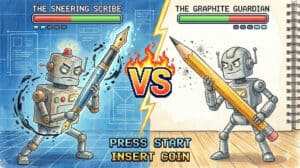
Which Dedicated AI Detector is Better ? TruthScan vs Winston AI
Both TruthScan and Winston AI were built specifically to catch AI-generated content, which makes this a more interesting fight than most detector comparisons. We ran them through six controlled tests to find out whether enterprise-grade detection actually beats a tool built for the classroom. Spoiler: neither had a perfect run.

Mark Gotauco
Updated June 18, 2026

Reading Time: 6 minutes
There's a version of this comparison that writes itself. Enterprise fraud platform goes up against an educator's detection tool. Different audiences, different use cases, easy conclusion.
Run your writing through Undetectable AI to see detection risk and clean it up before you submit or publish.
But that framing undersells what Winston AI actually is, and it also lets TruthScan off too easy. Winston isn't a productivity tool with detection bolted on as an afterthought.
What makes this matchup interesting is that both tools are dedicated detectors. They just came to the same problem from very different directions.
TruthScan was built for enterprise security teams dealing with synthetic media at scale.
Winston was built for educators reviewing student submissions. Same core task, different context, different priorities.
We put both through the same six tests to see which one actually performs better where it counts. Here's what the numbers showed.
What is TruthScan?
TruthScan is an enterprise-grade AI detection platform built to identify synthetic content across text, images, video, audio, and documents. It operates under Undetectable LLC out of Sheridan, Wyoming, and was designed from the ground up for security teams, media organizations, and identity verification pipelines that need detection to work reliably at scale.
It's one of the few tools in this space that serves enterprise clients while keeping a public-facing version accessible for individual use.
Core Features:
- AI text detection for outputs from ChatGPT, Claude, Gemini, LLaMA, and other major models, with sentence-level scoring and per-sentence confidence percentages
- AI image detection with heatmaps showing which areas of an image are synthetic, covering DALL-E, Midjourney, Stable Diffusion, and 100+ generators
- Deepfake video detection with frame-by-frame facial authentication, supporting Sora 2, HeyGen, Runway Gen-4, Kling AI, Google Veo 3, and more
- AI audio and voice clone detection powered by a proprietary algorithm called Aletheia
- Email scam detection for AI-generated phishing and fraud content
- Document and fake receipt authentication for identity verification pipelines
- SOC 2 Type II and ISO 27001 compliance
- Real-time API with detailed JSON responses, audit logs, and enterprise SSO
Pricing:
- Free trial: 20,000 credits, no credit card required
- Professional: $49/month, roughly 2,000 text pages worth of scans
- Silver: $199/month, 10,000 text pages
- Gold: $499/month, 34,000 text pages
- Platinum: $999/month, 100,000 text pages
- Enterprise: Custom pricing with volume discounts of 80% or more.
What is Winston AI?
Winston AI is a text-focused detection platform built primarily for educators and publishers. It has a legitimate track record in academic settings and comes with workflow features like OCR scanning and Google Classroom integration that make it genuinely useful for teachers reviewing physical or digital submissions at volume.
Where it gets more complicated is accuracy. Winston claims 99.98% detection accuracy, but that number should be treated with some skepticism until you see how it performs yourself..
Core Features:
- AI text detection for outputs from ChatGPT, Claude, Gemini, LLaMA, and other major models with sentence-level color-coded scoring
- OCR scanning for PDFs, scanned documents, and printed materials
- Built-in plagiarism checker on Advanced and Elite plans
- Multi-language detection across ten languages including Spanish, French, German, and Chinese
- AI image detection covering Midjourney, DALL-E, Stable Diffusion, and Adobe Firefly
- HUMN-1 and HUMN-2 website certification for publishers wanting to verify human-written content
- Google Classroom integration and exportable PDF reports
Pricing:
- Free: Limited scans with basic features
- Essential: $12/month, core text detection
- Advanced: $19/month, adds plagiarism checker and HUMN-1 certification
- Elite: $49/month, adds HUMN-2 certification and priority features
- Team plans available for schools and editorial organizations
A Quick Note on Privacy
Both tools process submitted text through their servers, so avoid uploading anything sensitive without knowing what happens to it afterward.
TruthScan states that submitted content is not stored and is not used for model training.
Winston AI stores scans within user accounts to support its reporting and PDF export workflow. Worth reviewing before running sensitive student data or proprietary content through it.
The Test Setup
Six samples, chosen to cover the range of scenarios a real detection tool needs to handle.
- Test 1: AI-generated essay from ChatGPT
- Test 2: AI-generated essay from Gemini
- Test 3: AI-generated essay from Claude
- Test 4: A humanized version of one of the AI essays, processed to reduce detection signals
- Test 5: A published news article written by a human journalist
- Test 6: An excerpt from a peer-reviewed PubMed research paper
Tests 5 and 6 are the controls. Both are verifiably human-written and should score near zero on any detector. The humanized sample is the stress test, the kind of AI writing that shows up in real academic submissions specifically because it's designed to avoid detection.
TruthScan vs Winston AI The Results
Test 1: ChatGPT
TruthScan: Correctly Flagged the text as AI- Generated
AI Likelihood Score: 97%

Winston AI: Correctly Flagged the text as AI- Generated
AI Likelihood Score: 100%

Test 2: Gemini-Generated Text
TruthScan: Flagged the text as Partially AI-Generated
AI Likelihood Score: 43%

Winston AI: Incorrectly identified the text as Human Written
AI Likelihood Score: 15%

Test 3: Claude-Generated Text
TruthScan: Flagged the text as Partially AI-Generated
AI Likelihood Score: 58%

Winston AI: Correctly Flagged the text as AI- Generated
AI Likelihood Score: 100%

Test 4: Humanized AI Text
TruthScan: Correctly identified the text as Human Written
AI Likelihood Score: 1%

Winston AI: Correctly identified the text as Human Written
AI Likelihood Score: 0%

Test 5: Published News Article (Human)
TruthScan: Correctly identified the text as Human Written
AI Likelihood Score: 1%

Winston AI: Correctly identified the text as Human Written
AI Likelihood Score: 4%

Test 6: PubMed Research Excerpt (Human)
TruthScan: Gave a Likely Human verdict
AI Likelihood Score: 26%

Winston AI: Correctly identified the text as Human Written
AI Likelihood Score: 0%
Results Summary
| Test | TruthScan | Winston AI |
| #1 ChatGPT Text | 97% | 100% |
| #2 Gemini Text | 43% | 15% |
| #3 Claude Text | 58% | 100% |
| #4 Humanized Essay | 1% | 0% |
| #5 News Article | 1% | 4% |
| #6 PubMed Excerpt | 26% | 0% |
| Correct Verdicts | 4/6 | 4/6 |
For a broader classroom-focused list, see our guide to AI writing and plagiarism checkers for teachers.
For another classroom-focused detector matchup, read our TruthScan vs Proofademic test.
My Final Thoughts
Neither tool completed more than four of the test’s six rounds, so no blowout here. But each tool’s path there is a different story.
TruthScan performed much better overall. It got ChatGPT at 97%, it did properly clear the news article and humanized sample, and it never gave back a result that could get an innocent piece of writing in a real mess.
The slightly weaker results on Gemini, with 43%, and Claude 58% represent real gaps, and the PubMed sample coming in at 26% is too high. But over six tests, it was never as way off the mark as Winston was with Gemini.
Winston had its moments. They hit a perfect score of 100% with ChatGPT and Claude, which is honestly impressive, and it nailed the human controls with no sweat.
But 85% Human rating for a straight Gemini text is a significant error, especially for a tool that people in education use, and where that sort of material is progressively more prevalent.
If the result matters for real, TruthScan gives you a bit more to work with. Just don't treat any score from either tool as the final word.
Want to Learn Even More?
If you enjoyed this article, subscribe to our free newsletter where we share tips & tricks on how to use tech & AI to grow and optimize your business, career, and life.