Why Companies Are Switching from Upwork to LATAM Staffing Platforms
Upwork has a fee problem, a quality problem, and a loyalty trap baked right into its terms of service. Companies that figured this out are moving their full-time remote hiring to LATAM staffing platforms, and the cost difference alone is enough to make you wonder why anyone stuck around this long.

Mark Gotauco
Updated June 18, 2026

Reading Time: 9 minutes
I've hired through Upwork. Multiple times. And for quick one-off projects, it worked fine. But the moment I tried to use it for ongoing, full-time remote hires, the cracks showed up fast.
The fees stack up in ways you don't expect. The talent quality is wildly inconsistent. And you spend more time sorting through proposals than actually getting work done.
I'm not the only one noticing. A growing number of companies (especially US-based startups and mid-market teams) are ditching Upwork entirely for dedicated LATAM staffing platforms.
Not because LATAM is trendy, but because the math just works better.
Here's what's actually going on.
The Real Cost of Hiring on Upwork
Upwork markets itself as a straightforward freelancer marketplace. Post a job, get proposals, hire someone. Simple enough. But the fee structure tells a different story.
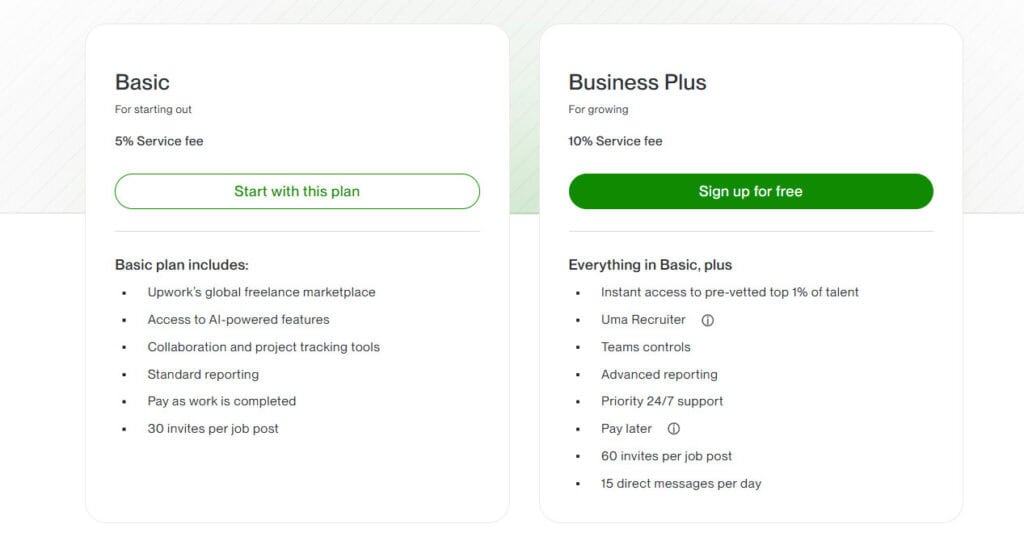
For clients on the Marketplace plan, you're paying a 5% service fee on every payment to a freelancer (3% if you pay via ACH from a US bank account). That's on top of the freelancer's rate. And there's a contract initiation fee of $0.99 to $14.99 every time you start a new contract.
For the Business Plus plan ($49.99/month), the fee jumps to 10% (8% with ACH). You get some extra features like team collaboration tools and compliance support, but you're paying significantly more per dollar spent on talent.
For freelancers, things got worse in 2025. Upwork moved from a flat 10% service fee to a variable model of 0% to 15% per contract. The fee is set when the contract starts and depends on "market dynamics," which is a vague way of saying Upwork decides what to charge based on supply and demand. Most freelancers report fees landing in the 10-15% range for typical contracts.
So let's do the math on a real scenario.
You hire a developer at $40/hour through Upwork. You're paying $42 per hour (with the 5% client fee). The developer receives somewhere between $34 and $40, depending on their service fee.
Over a full-time year (2,080 hours), you're spending roughly $87,360. The developer might take home $70,720 to $83,200. Upwork pockets the difference.
And that's before we talk about Connects.
The Hidden Costs Nobody Mentions Upfront
Freelancers on Upwork need "Connects" to submit proposals. Each Connect costs $0.15, and most job proposals require 12 to 24 Connects. That's $1.80 to $3.60 per proposal.
Free accounts "used to" get 10 Connects per month. That's barely enough for two proposals.
Why does this matter to you as the hiring company? Because good freelancers are selective about which jobs they bid on.
The Connect system means top talent won't waste money applying to vague or low-budget postings. So your job post might get 50 proposals, but the best candidates may have skipped it entirely.
Then there's the conversion fee. If you find a great freelancer on Upwork and want to hire them directly (off-platform), Upwork charges 13.5% of the freelancer's projected annual earnings.
For a developer earning $80,000/year, that's $10,800 just to take the relationship off Upwork. And this penalty applies for a full 24 months after your last Upwork contract with that person.
That's not a fee. That's a trap.
Quality Problems That Waste Your Time
The fee issue would be tolerable if talent quality was consistently high. It's not.
Agencies posing as freelancers. This is one of the most common complaints on Upwork in 2025 and 2026. You think you're hiring an individual developer or designer, but the profile is actually run by an agency. The person you interview isn't the person doing the work. The actual worker might be junior, might be in a completely different time zone, and might not speak English as well as the profile suggests.
Inflated profiles and gamed reviews. Upwork's Job Success Score system creates perverse incentives. Freelancers game it by only accepting easy jobs, asking friends for positive reviews, or closing contracts early to avoid potential negative feedback. A 95% Job Success Score doesn't tell you much about actual skill level.
Race to the bottom on pricing. Because Upwork is a global marketplace, US companies posting jobs get flooded with proposals from freelancers willing to work for $5-10/hour. Sorting through 40+ proposals to find the 2-3 serious candidates is time you're not getting back.
No cultural or time zone filtering. Upwork lets you filter by location, but it doesn't screen for cultural fit, English fluency, or working-hour overlap the way dedicated regional platforms do. You're doing all that screening yourself.
I've seen teams spend 10+ hours per hire just reviewing proposals, conducting test tasks, and dealing with early-stage mismatches. That's a hidden cost that doesn't show up in any fee breakdown.
Why LATAM Platforms Solve These Problems
Dedicated LATAM staffing platforms exist because Upwork's model doesn't work well for companies that want reliable, full-time, time-zone-aligned remote employees. Here's what changes when you use a regional platform instead.
Pre-Screened Talent Pools
LATAM platforms do the vetting before you ever see a candidate. English fluency assessments, technical skill evaluations, previous employer verification, cultural fit screening. The candidates you see have already passed filters that would take you hours to apply yourself on Upwork.
Time Zone Alignment Built In
This is a bigger deal than most people realize. Latin American professionals work in US time zones (or within 1-3 hours of them). That means real-time collaboration, same-day responses, and no 12-hour communication gaps. On Upwork, you might hire someone in Southeast Asia because their rate was $10/hour cheaper, and then lose that savings (and more) to delays and miscommunication.
Transparent, Simpler Pricing
No variable service fees. No Connect costs. No conversion penalties. Most LATAM platforms charge either a flat monthly fee, a one-time placement fee, or a simple platform subscription. You know what you're paying before you start.
Actual Cost Savings (With Numbers)
A senior software developer in the US typically earns $130,000 to $160,000+ per year. The same caliber of developer in Latin America, hired through a dedicated platform, earns $45,000 to $80,000 depending on the country and specialization. That's a 50-65% savings, and you're getting someone in your time zone who's been pre-vetted for English fluency and technical ability.
On Upwork, you might find similar rates, but you're paying Upwork's fees on top, doing all the vetting yourself, and risking the agency-posing-as-freelancer problem.
Cost Comparison (Real Numbers)
Here's what it actually looks like to hire a full-time senior developer through each channel.
| Upwork | LATAM Staffing Agency | LATAM Self-Service Platform | |
|---|---|---|---|
| Developer annual compensation | $60,000-$80,000 | $50,000-$75,000 | $45,000-$75,000 |
| Platform/agency fees | 5-10% of all payments ($3,000-$8,000/yr) | One-time 25-35% of salary or flat monthly fee | $48-$88/month ($576-$1,056/yr) |
| Freelancer service fee | 0-15% (reduces developer take-home) | None (salary is salary) | None |
| Conversion/exit fee | 13.5% of annual salary to hire off-platform | Varies by contract | None |
| Contract initiation | $0.99-$14.99 per contract | None | None |
| Vetting included | No (self-service) | Yes (agency-screened) | Yes (platform-screened) |
| Time zone guarantee | No | Yes (LATAM-only) | Yes (LATAM-only) |
| EOR/payroll support | No | Often included | Usually not included |
| Total first-year cost (estimated) | $66,000-$96,000+ | $62,500-$101,250 | $45,576-$76,056 |
The self-service LATAM platform model stands out here. You're paying significantly less in fees because you're handling the hiring process yourself, but the candidates are still pre-screened, still in your time zone, and still verified for English fluency.
Which LATAM Platforms Are Worth Looking At
A few platforms have emerged as the main players in this space. Each takes a slightly different approach.
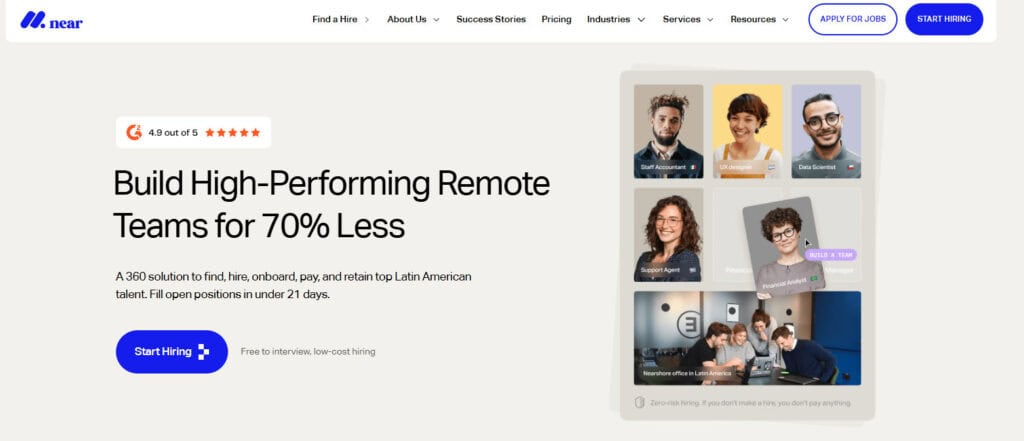
Near is probably the most well-known. They operate as a full-service recruiting agency for LATAM talent, with a 180-day replacement guarantee and strong G2 reviews (4.9/5 with 100+ reviews).
But they charge around 30% of annual salary as a placement fee, which makes them better suited for mid-market and enterprise companies with bigger budgets.
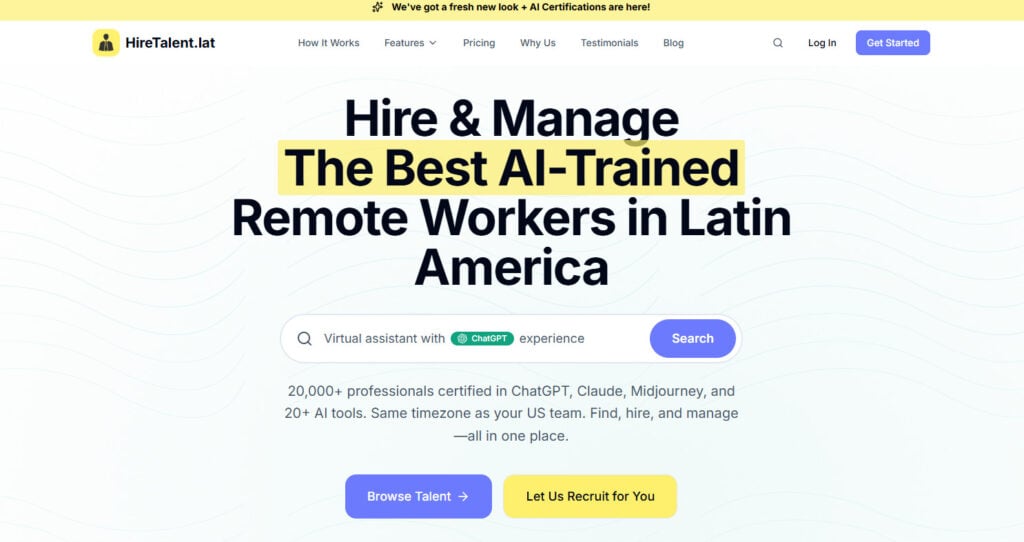
HireTalent takes the opposite approach. It's a self-service platform where you search and connect with pre-screened LATAM candidates directly. Job posts start at $48, and full platform access is $88/month.
No percentage-of-salary fees, no placement costs. Candidates with "vetted" badges have been verified by previous employers. It's the most affordable option if you're comfortable running your own hiring process.

South sits in the middle, offering both a staffing model (flat monthly fee) and a headhunting model (one-time fee) with a 120-day replacement guarantee.
They publish some of the best salary benchmark data in the LATAM space, which is helpful even if you don't use their service.

Tecla specializes in software developers only, with a network of 40,000+ senior engineers across 18 LATAM countries.
Rates range from $15-$70/hour, and they handle EOR, payroll, and compliance. Good option if you're hiring strictly for engineering roles.
When Upwork Still Makes Sense
I don't think Upwork is terrible. It's just not the right tool for full-time remote hiring.
Upwork still works well for short-term, project-based work. Need a logo designed? A one-time data migration? A freelance writer for three blog posts? Fine. The marketplace model is built for that.
But the moment you're looking for someone to work 40 hours a week, integrate with your team, and stay for 6-12+ months, you're fighting against Upwork's entire fee structure and talent model. You'll spend more time screening, pay more in fees, and face the conversion penalty if you ever want to take the relationship direct.
For that kind of hiring, dedicated LATAM platforms just make more sense.
For broader marketplace alternatives, see our guide to top alternatives to Upwork for hiring remote workers.
Final Verdict
The shift from Upwork to LATAM-specific platforms isn't a fad. It's companies getting smarter about where their hiring dollars go.
Upwork's stacking fees (5-10% client fee, 0-15% freelancer fee, Connect costs, contract initiation fees, and that brutal 13.5% conversion fee) add up to a significant tax on every hire. And you're still doing all the vetting, screening, and quality control yourself.
LATAM staffing platforms solve the real problems. Pre-vetted talent. Time zone alignment. Simpler pricing. If you have the budget and want a hands-off experience, agencies like Near or South will run the process for you. If you'd rather save on fees and handle hiring directly, a platform like HireTalent gives you access to screened LATAM candidates for less than a hundred bucks a month.
More companies will make this switch over the next year or two. The talent in Latin America is strong, the cost savings are real, and the Upwork fee model just isn't built for long-term team building. So if you're still running full-time hires through Upwork, it might be time to rethink that.
Want to Learn Even More? If you enjoyed this article, subscribe to our free newsletter where we share tips and tricks on how to use tech and AI to grow and optimize your business, career, and life.
Want to Learn Even More?
If you enjoyed this article, subscribe to our free newsletter where we share tips & tricks on how to use tech & AI to grow and optimize your business, career, and life.