The Free Tool or the Forensic Tool Which is Better? ImageDetector vs ImageWhisperer
Anyone can spot a melting ear. The real question is what happens when the image has been touched just enough to look clean. We ran ImageDetector and ImageWhisperer through four tests to find out where the free tool ends and the forensic one begins.

Mark Gotauco
Updated June 18, 2026

Reading Time: 5 minutes
Early AI Generated Images outputs had tells everywhere. Extra fingers. Melting ears. Light sourced from nowhere. Anyone paying attention could spot them.
So people started paying attention.
Then the generators caught up. Midjourney v6 started clearing the bar for editorial photography. ChatGPT added native image generation that passed for stock. Gemini followed.
The artifacts got smaller, rarer, and harder to catch without help.
ImageDetector and ImageWhisperer are two tools trying to answer that question. They just go about it completely differently. One is built for speed. The other is built like a forensic tool
We ran both through six tests to find out which approach actually holds up.
What is ImageDetector?
ImageDetector is a browser-based AI image detector built for quick, frictionless checks. Upload an image or paste a URL and you get an AI likelihood score in seconds.
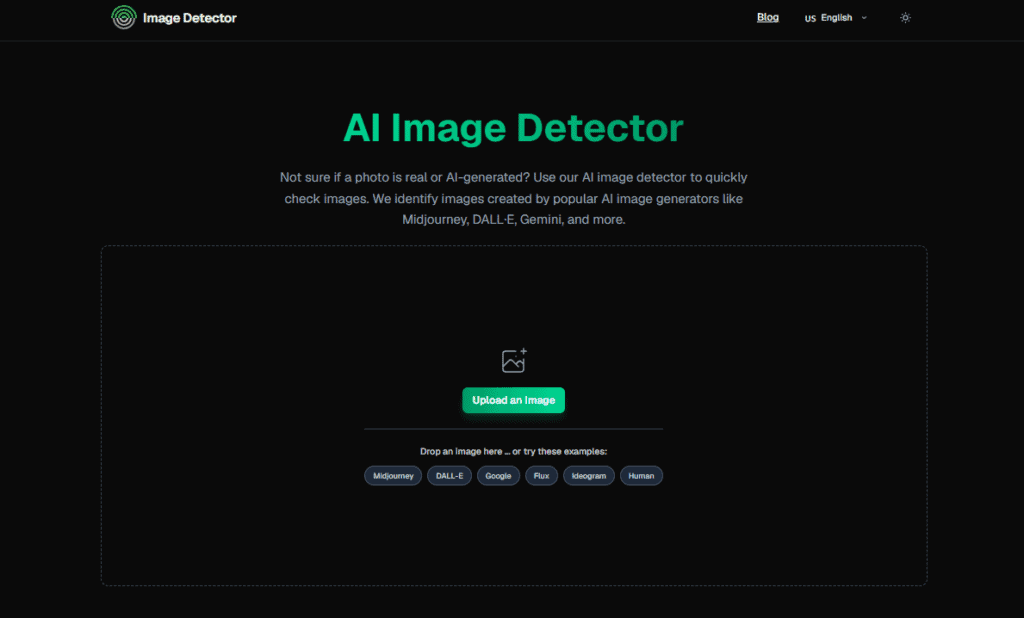
It works across JPG, PNG, and WEBP formats and is specifically built to handle images that have already been through the social media cycle shared, screenshotted, recompressed, cropped, and re-uploaded multiple times.
That matters more than it sounds. Most AI images people encounter in the wild aren't clean generations. They've been processed.
The output is a single numerical probability score. No narrative, no explanation. Just a number and a verdict. For creators running quick checks across a volume of content, that simplicity is the point.
Pricing is straightforward: it's free.
What is ImageWhisperer?
ImageWhisperer is not trying to be fast. It's trying to be thorough.
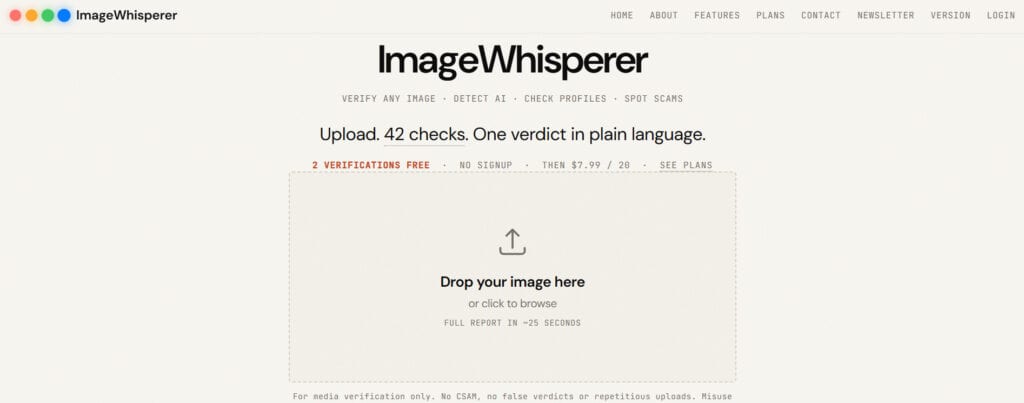
It markets itself as a forensic image detective agency and that framing holds up. A single verification runs 41 independent checks across five categories: AI detection models, editing and manipulation detectors, AI visual inspections, forensic file analysis, and external verification. The output isn't a score. It's a case file.
Verdicts come in four colors. Red means AI-generated. Orange means uncertain. Green means no AI detected. Blue means conflicting evidence that needs human review. Each verdict comes with a plain-language narrative explaining the reasoning.
Pricing runs on pay-as-you-go bundles:
- Free: 2 verifications per day
- $1 Unlock: 2 verifications, valid for 1 day
- Try ($4): 10 verifications, valid for 30 days
- Starter ($7.19): 20 verifications, valid for 60 days
- Professional ($26.39): 100 verifications, valid for 60 days, adds follow-up questions, no-storage and no-training guarantees, and priority support
- Enterprise (from $250/month): 600 verifications per month, CMS integration, PDF reports, multi-user collaboration, and image monitoring
A Quick Note on Privacy
Both tools process uploaded images through their servers, so avoid submitting anything sensitive, proprietary, or client-owned.
If content ownership matters to your workflow, check privacy policies directly before uploading anything you wouldn't want logged.
The Test Setup
Four tests total.
Two AI-generated images, one each from ChatGPT and Gemini.
A real photograph and the same photograph with visible post-processing edits applied.
The reason for two different generators is that ChatGPT and Gemini each leave different fingerprints.
Test 3 is the clean control. Test 4 pushes that further. Edited photos sit in an uncomfortable middle ground real in origin but processed enough that detection logic can misread them.
Getting that one right matters.
ImageWhisperer's free tier allows two verifications per day. Running this four-test comparison consumed two full days of free access.
That's worth keeping in mind.
ImageDetector vs ImageWhisperer AI Image Detection Results
Test 1: ChatGPT Generated Image
ImageDetector: Correctly Flagged the image as AI Generated
AI Likelihood Score: 99%

ImageWhisperer: Correctly Flagged the image as AI Generated
AI Likelihood Score: 99%

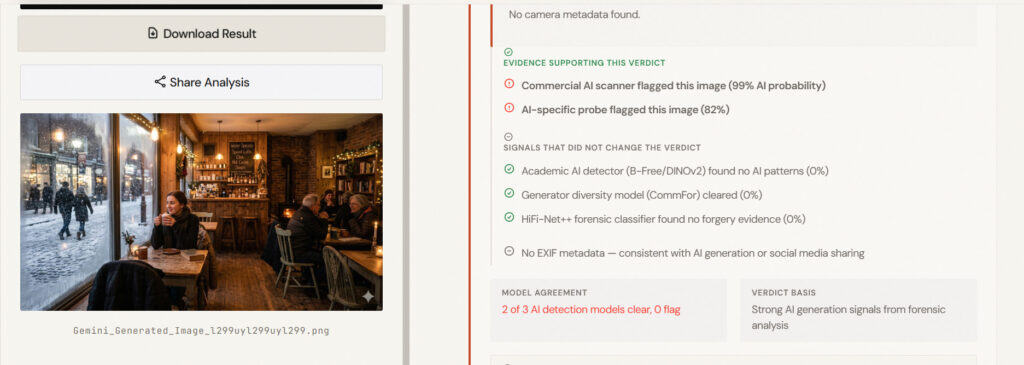
Test 2: Gemini-Generated Image
ImageDetector: Correctly Flagged the image as AI Generated
AI Likelihood Score: 99%

ImageWhisperer: Correctly Flagged the image as AI Generated
AI Likelihood Score: 99%
Test 3: Raw Photograph
ImageDetector: Correctly identified the image as Real
AI Likelihood Score: 3%

ImageWhisperer: Correctly identified the image as Real
AI Likelihood Score: 0%

Test 4: Edited Photograph
ImageDetector: Correctly identified the image as Real
AI Likelihood Score: 11%

ImageWhisperer: Correctly identified the image as Real
AI Likelihood Score: 0%

Results Summary
| Test | ImageDetector | ImageWhisperer |
| ChatGPT Image | 99% | 99% |
| Gemini Image | 99% | 99% |
| Real Photo | 3% | 0% |
| Edited Photo | 11% | 0% |
| Correct Verdicts | 4/4 | 4/4 |
My Final Thoughts
The AI detection results were identical. 99% on ChatGPT, 99% on Gemini. Neither tool blinked.
Most people aren't worried about spotting a pristine AI generation. Those are becoming easier to flag. The harder question is what happens when a real image has been touched.
Cropped, filtered, retouched, or manipulated in ways that change what it's communicating without making it obviously fake. That's the scenario that actually fools people.
ImageDetector read 11% on the edited real photo. That's not a mistake. That's the tool picking up on post-processing and flagging that something was done to the image. .
ImageWhisperer returned zero on the same image. Which sounds more confident but tells a different story. It looked past the processing, found the camera fingerprint underneath, and called it real.
That's the forensic stack doing its job. The problem is that getting to that result costs you one of your two free daily scans.
For quick checks where you just need a reliable verdict, ImageDetector costs nothing and you get practically the same results.
If you need to know not just whether an image is real but whether it has been altered and how, ImageWhisperer is the more in depth tool as it should
Just know that honesty comes with a price tag attached.
For another image-detector matchup, read our Undetectable AI vs Sightengine test.
Want to Learn Even More?
If you enjoyed this article, subscribe to our free newsletter where we share tips & tricks on how to use tech & AI to grow and optimize your business, career, and life.