Which Tool Detects AI Images Better: ImageDetector vs Sightengine
AI-generated portfolios are already making it past admissions panels and most instructors have no reliable way to prove what they're looking at. A gut feeling isn't a verdict. That's the exact problem these two tools are supposed to solve.

Mark Goutaco
Updated April 1, 2026

Which Tool Detects AI Images Better: ImageDetector vs Sightengine
Reading Time: 4 minutes
An art student submits a portfolio. The work looks stunning. The professor is impressed. So is the admissions panel.
The only problem? None of it came from a sketchbook.
This is already happening. Fine art programs, design schools, and photography courses are seeing AI-generated work submitted as original.
And most instructors have no reliable way to prove what they're looking at.
A gut feeling isn't a verdict.
That's exactly the kind of problem ImageDetector and Sightengine are supposed to solve.
So we tested both. Six images, no favorable conditions, no cherry-picked inputs.
Here's what we found.
What is ImageDetector?
ImageDetector is a dedicated AI image detection tool built for one job, telling you whether an image is real or AI generated, that’s it.
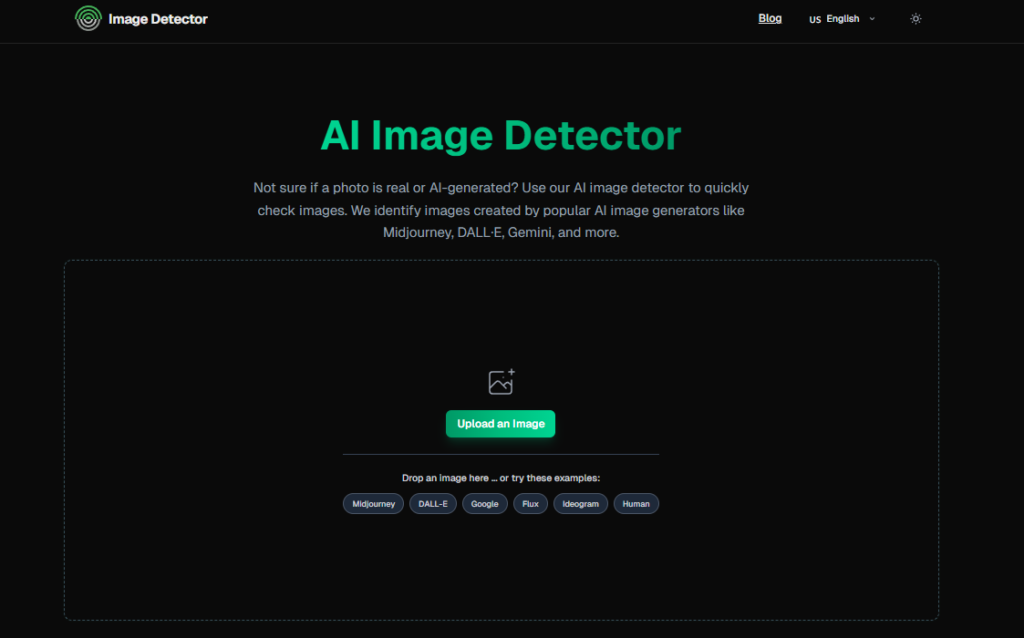
The interface is straightforward. Upload an image, get a percentage score.
There's no feature bloat, no upsell buried in the dashboard. It's built for people who need a fast, clear answer.
What makes it interesting is the focus. Most tools in this space treat image detection as one checkbox among many. ImageDetector built the whole product around it.
What is Sightengine?
Sightengine is a content moderation API.

AI image detection is part of a broader system that also handles nudity filtering, violence detection, face analysis, and more.
The platform is built for developers and enterprise teams who need to run images through automated pipelines.
You're not uploading one photo at a time, you're plugging it into a workflow.
The AI detection feature gives you a probability score, same concept as ImageDetector, but the context around it is completely different.
It's a powerful tool. But it's built for scale, not simplicity.
What I Tested and Why
I ran six images through both tools.
Four were AI-generated (one each from ChatGPT, Gemini, Midjourney, and Stable Diffusion).
Two were real photos taken on a phone (one completely raw, one cropped and edited).
The goal was to cover the full range. Obvious AI outputs. Newer model outputs designed to look photorealistic.
Genuinely real photos. And a real photo with minor edits that could trip up a detector looking for manipulation signals.
I already know what each image is. The question is whether the tools do too.
ImageDetector vs Sightengine: AI Image Detection
Test 1: ChatGPT
ImageDetector: Correctly flagged the image as AI-Generated
AI Likelihood Score: 99%
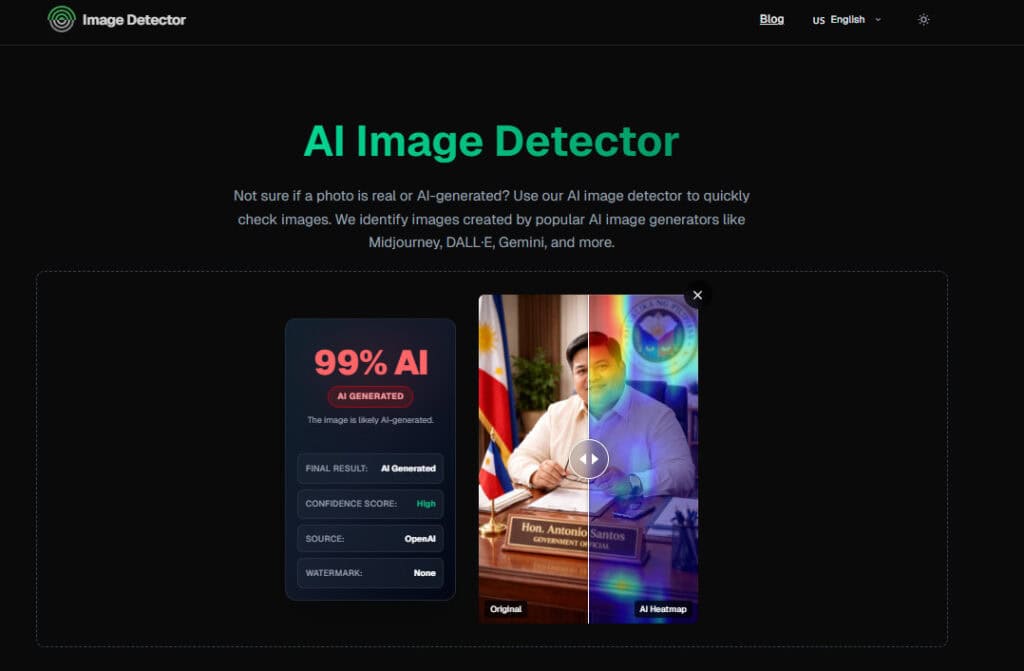
SightEngine: Correctly flagged the image as AI-Generated
AI Likelihood Score: 99%

Test 2: Gemini-Generated Image
ImageDetector: Correctly flagged the image as AI-Generated
AI Likelihood Score: 99%

SightEngine: Correctly flagged the image as AI-Generated
AI Likelihood Score: 99%

Test 3: Midjourney-Generated Image
ImageDetector: Correctly flagged the image as AI-Generated
AI Likelihood Score: 99%

SightEngine: Was uncertain if the image is Real or AI- Generated
AI Likelihood Score: 37%

Test 4: Stable Diffusion
ImageDetector: Correctly flagged the image as AI-generated
AI Likelihood Score: 98%

SightEngine: Correctly flagged the image as AI-generated
AI Likelihood Score: 99%

Test 5: Real Photo (Raw, Unedited)
ImageDetector: Correctly identified the image as Real
AI Likelihood Score: 12%

SightEngine: Correctly identified the image as Real
AI Likelihood Score: 1%

Test 6: Real Photo (Digitally Edited)
ImageDetector: Correctly identified the image as Real and Digitally Altered
AI Likelihood Score: 33%

SightEngine: Did not flag any digital alterations and passed the image as Real
AI Likelihood Score: 1%

Score Summary
Score Summary
| Test | Image Type | ImageDetector | Sightengine |
| #1 | ChatGPT | 99% | 99% |
| #2 | Gemini | 99% | 99% |
| #3 | Midjourney | 99% | 37% |
| #4 | Stable Diffusion | 98% | 99% |
| #5 | Real photo (raw) | 12% | 1% |
| #6 | Real photo (edited) | 33% | 1% |
| Average Score | 90% | 56% | |
| Correct Calls | 6/6 | 4/6 |
Final Thoughts
ImageDetector went 6 for 6. Sightengine went 4 for 6.
ChatGPT, Gemini, and Stable Diffusion outputs were caught by both with near-perfect confidence.
Where things got interesting was Midjourney and the cropped photo. Midjourney's outputs have gotten uncomfortably close to real photography, and that's a known challenge for most AI detectors.
But Sightengine's 37% score didn't just reflect uncertainty, it failed to return a verdict at all.
ImageDetector looked at the same image and came back at 99% AI without flinching.
The cropped photo is worth noting too. The image wasn't manipulated in any meaningful way — just cropped.
Simple edit, nothing too technical.
Sightengine passed it through at 1% with no flags. ImageDetector caught that something was off and flagged the alteration alongside the “Human” classification.
A small difference, but the kind of detail that matters when the stakes are higher than a practice run.
That's why for accurate image detection you have to give it to ImageDetector.
Want to Learn Even More?
If you enjoyed this article, subscribe to our free newsletter where we share tips & tricks on how to use tech & AI to grow and optimize your business, career, and life.