Top Alternatives to Upwork for Hiring Remote Workers
Upwork's fees are quietly eating into every hire you make, and the proposal flood isn't getting better. I dug into 10 alternatives that actually work, broke down the costs, and called out who each platform is and isn't right for. If you've been defaulting to Upwork out of habit, this might change that

Mark Goutaco
Updated April 7, 2026

Best Upwork Alternatives for Hiring Remote Workers
Reading Time: 13 minutes
Upwork is the first platform most people think of when they need to hire a freelancer or remote worker. And for years, it deserved that spot. But the platform has changed a lot recently, and not all of it is good news for employers.
The fees keep climbing. Upwork now charges clients a marketplace fee that can float up to 7.99% on every dollar you send, including hourly payments, milestone releases, bonuses, and even reimbursed expenses.
On top of that, there's a contract initiation fee ($0.99 to $14.99) every time you start a new engagement. And if you want to hire a freelancer full-time outside of Upwork within two years? That'll cost you a conversion fee of 13.5% of one year of their projected earnings.
The talent pool is massive, sure. But massive cuts both ways. You'll spend hours sifting through proposals from people who clearly didn't read your job post.
I've posted jobs on Upwork and received 50+ applications within the first hour, with maybe three worth reading.
So I went looking for better options. Here are 10 Upwork alternatives worth your time, depending on what you're hiring for.
How I Picked These
I looked at actual pricing (not just what's on the marketing page), fee structures for employers specifically, talent quality and vetting processes, and what types of roles each platform handles best.
I also factored in real user reviews from G2, Trustpilot, and Clutch where available.
Not every platform here is a direct Upwork clone. Some are specialized marketplaces. Some are job boards.
Some are regional platforms that focus on a specific talent pool. That's the whole point. The best alternative depends entirely on what you're hiring for.
The 10 Best Upwork Alternatives
1. Toptal
Best for: Companies that want pre-vetted senior talent and don't mind paying premium rates
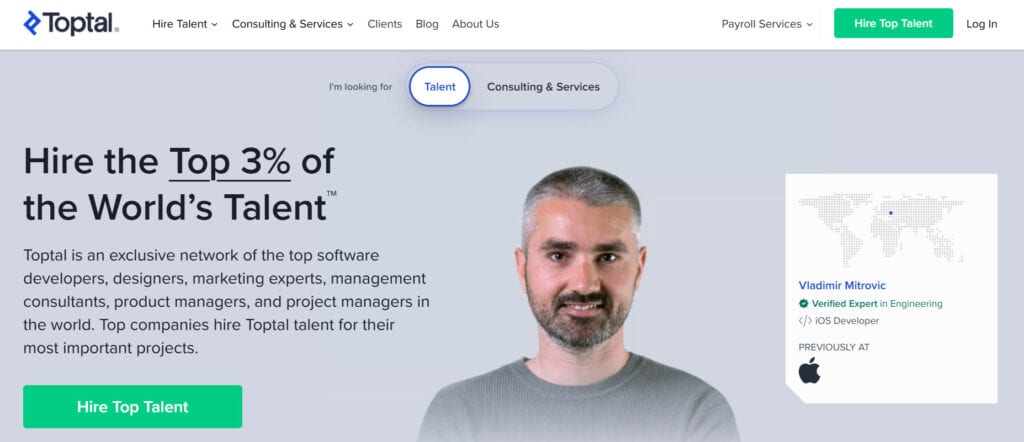
Toptal claims to accept only the top 3% of applicants, and from what I've seen, their screening process is genuinely tough. Multiple rounds of interviews, live coding challenges, and test projects. The quality shows.
The catch? It's expensive. Blended hourly rates typically fall between $60 and $150 per hour, with specialized engineers and AI consultants pushing past $200. Toptal folds its margin into that rate, so what you see is what you pay. No separate platform fee. But you will need to authorize a refundable $500 deposit before you can start interviewing, plus there's a $79/month subscription.
The two-week trial period is a nice safety net. If the freelancer doesn't work out in the first two weeks, you don't pay.
Employer cost: $60 to $200+/hr blended rate, $500 refundable deposit, $79/mo subscription
Pros:
- Extremely rigorous vetting (top 3% claim is backed by a real process)
- Two-week risk-free trial
- Strong for developers, designers, and finance experts
Cons:
- Rates are often comparable to US-based talent
- $500 deposit and monthly subscription required before you hire anyone
- Not great for entry-level or mid-level roles
2. HireTalent
Best for: Founders and hiring managers who want to hire directly from Latin America without agency markups
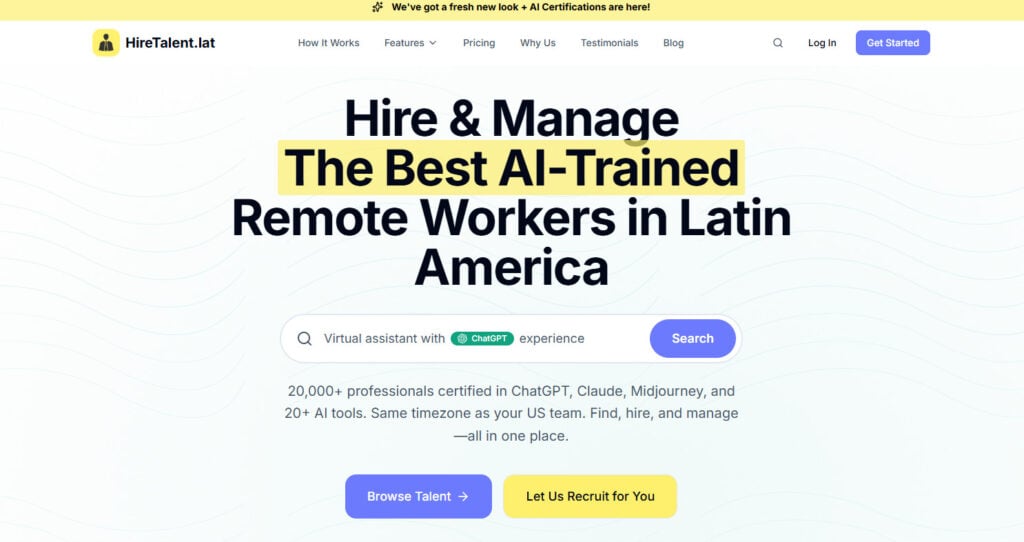
If you're specifically looking to hire remote workers from Latin America, this is the platform I'd check first. HireTalent takes a completely different approach than Upwork.
Instead of an open marketplace where anyone can sign up and bid on jobs, every candidate goes through an initial screening process before they're allowed on the platform.
Talent with purple "vetted" badges have been verified by previous employers who actually worked with them.
The pricing model is refreshingly simple. $48 for a single job post, or $88/month for full platform access including talent search and direct messaging.
No percentage of salary. No placement fees. You negotiate compensation directly with your hire.
Employer cost: $48 per job post or $88/mo for full access
Pros:
- No agency markups or percentage-based fees
- Pre-screened LATAM talent with employer-verified profiles
- Direct communication with candidates from day one
- Custom trial tasks to evaluate before hiring
- Time zone alignment with US companies
Cons:
- You handle the screening and interviewing yourself
- No built-in payroll or EOR services
- Newer platform, so the talent pool is still growing
3. Fiverr
Best for: One-off tasks and small projects where you need fast turnaround

Fiverr flipped the freelancing model on its head when it launched. Instead of posting a job and waiting for proposals, you browse "gigs" that freelancers have already packaged with clear deliverables and pricing.
Need a logo designed, a video edited, or a WordPress plugin installed? You can find someone and get started within minutes.
For employers, Fiverr charges a 5.5% service fee on orders, plus a small fixed fee ($2 on orders under $50).
The Business Plus plan at $49.99/month gives you a dedicated success manager and branded dashboard, though the service fee bumps up to 8 to 10%.
Where Fiverr falls short is ongoing work. It's built for projects, not relationships. If you need a developer for six months or a marketing manager on retainer, this isn't the right tool.
Employer cost: 5.5% service fee (or 8 to 10% on Business Plus at $49.99/mo)
Pros:
- Fastest way to get a small project done
- Clear upfront pricing on every gig
- Fiverr Pro tier has genuinely vetted freelancers
- Good for creative work (design, video, writing)
Cons:
- Not built for long-term or full-time hiring
- Quality is wildly inconsistent outside Pro tier
- 20% freelancer fee means top talent often avoids the platform
4. Freelancer.com
Best for: Budget-conscious employers who want maximum reach for simple projects

Freelancer.com is probably the closest direct alternative to Upwork in terms of structure. Post a job, get bids, pick someone. The talent pool is huge (60+ million users across 247 countries), and the fees are lower than Upwork on the employer side.
Clients pay just 3% or $3 (whichever is greater) on fixed-price projects, and 3% on hourly payments. That's notably cheaper than Upwork's floating marketplace fee.
The contest feature is also unique. You can post a design contest, receive multiple submissions, and only pay the winner.
But the lower barrier to entry means more noise. A lot more noise. Expect to wade through many low-quality proposals to find the good ones.
Employer cost: 3% or $3 minimum per project
Pros:
- Lower employer fees than Upwork
- Contest feature is great for design work
- Massive global talent pool
- Milestone-based payment protection
Cons:
- Proposal quality tends to be lower than Upwork
- Platform interface feels dated
- Optional listing upgrades ($10 to $22 each) add up fast
5. Contra
Best for: Employers who want a modern, commission-free platform for independent professionals
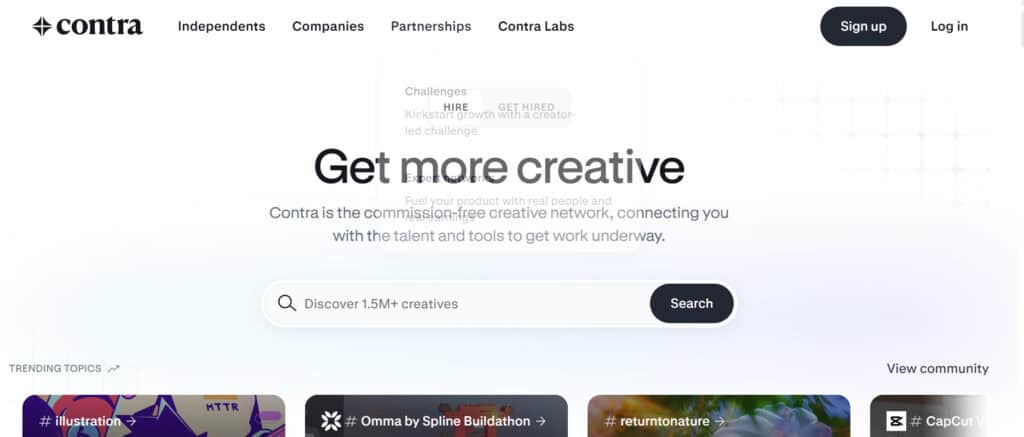
Contra has been growing fast by positioning itself as the anti-Upwork. Zero commission for freelancers means the platform attracts talent that's tired of losing 10 to 20% of their earnings elsewhere.
For employers, you pay a flat $29 per contract (one-time for a single project, or $29/month per contractor for ongoing work).
The profiles on Contra are portfolio-focused and well-designed. It feels more like browsing LinkedIn portfolios than scrolling through a job marketplace.
The quality skews toward creative and tech professionals, especially designers, developers, and marketers.
Employer cost: $29 per contract or $29/mo per contractor
Pros:
- Commission-free model attracts quality freelancers
- Clean, modern interface with portfolio-first profiles
- Flat, predictable pricing for employers
- Built-in invoicing and project management
Cons:
- Smaller talent pool than Upwork or Fiverr
- Less effective for finding entry-level or administrative talent
- Relatively new, so some features are still maturing
6. We Work Remotely
Best for: Companies hiring full-time remote employees (not freelancers)

We Work Remotely isn't a freelancer marketplace at all. It's a job board, and one of the most popular ones for remote positions. If you're looking to hire a full-time remote employee rather than a project-based freelancer, this is where serious remote workers go to find jobs.
Job listings cost $299/month and run for 30 days with automatic renewal. Bundle packages can save you up to 40% per post. The audience is strong, especially for tech, marketing, and customer support roles.
The platform doesn't handle vetting, interviewing, or payments. You post the job, candidates apply, and you take it from there.
Employer cost: $299/mo per job listing
Pros:
- High-quality remote job seekers (not gig workers)
- Great for full-time and long-term contract roles
- Strong in tech, design, and marketing
- Large audience of remote-first professionals
Cons:
- It's a job board, not a marketplace (no vetting or project tools)
- $299 per listing adds up if you're hiring multiple roles
- No payment protection or freelancer management features
7. PeoplePerHour
Best for: UK and European businesses hiring freelancers for web, marketing, and design projects

PeoplePerHour is big in Europe and especially popular in the UK. The platform has processed over 100 million pounds in payments and serves more than a million clients.
It works similarly to Upwork, with both a proposal system and pre-packaged "Hourlies" (similar to Fiverr gigs).
For employers, the fee is a straightforward 3.5% on top of the agreed price. That's lower than Upwork and Fiverr.
Freelancers pay a tiered commission (20% on the first 250 pounds with a client, dropping to 3.5% above 5,000 pounds), so long-term relationships are incentivized.
If your business is based in Europe or you want freelancers in European time zones, PeoplePerHour is worth a look. For US-based companies, the talent pool is less relevant.
Employer cost: 3.5% service fee
Pros:
- Lower employer fees than Upwork
- Strong European freelancer base
- Hourlies feature makes quick tasks easy
- Tiered freelancer fees encourage long-term work
Cons:
- Heavily UK/Europe-focused (less useful for US companies)
- Smaller talent pool than the major US platforms
- Interface can feel cluttered
8. Guru
Best for: Employers who want the lowest possible platform fees

Guru doesn't get talked about much, but it's been around since 1998 and has a loyal user base. The main selling point? Employer fees are almost nonexistent.
You pay a 2.9% handling fee on invoices, and if you pay via eCheck or wire transfer, that fee is completely waived.
The SafePay escrow system protects both sides, and the platform supports fixed-price, hourly, milestone, and recurring payment structures. It's flexible.
The downside is a smaller, less active talent pool compared to Upwork or Freelancer.com. But if keeping fees low is your top priority, Guru is hard to beat.
Employer cost: 2.9% handling fee (waived with eCheck/wire)
Pros:
- Lowest employer fees of any major marketplace
- SafePay escrow system for payment protection
- Flexible payment structures
- No monthly subscription required
Cons:
- Smaller and less active talent pool
- Platform design feels outdated
- Less third-party review data available
9. Hubstaff Talent
Best for: Companies that want zero platform fees and direct hiring

This is the most budget-friendly option on the list because it's completely free. No fees for employers. No fees for freelancers. No markups, no commissions, no middlemen. Hubstaff Talent is essentially a directory that connects businesses with remote professionals and agencies worldwide.
You post a job, freelancers apply, and you communicate directly. The platform doesn't handle payments, contracts, or disputes. It's just the connection point.
So what's the catch? Hubstaff (the parent company) makes its money from time-tracking software. The talent platform is a lead generator for that product. But you're not required to use it.
Employer cost: Free
Pros:
- 100% free for both employers and freelancers
- No commission on any payments
- Direct communication with talent
- Jobs get shared across multiple job boards
Cons:
- No vetting or quality control
- No payment protection or escrow
- You're completely on your own for screening
- Talent pool is smaller and less curated
10. OnlineJobs.ph
Best for: Companies hiring virtual assistants and remote workers from the Philippines

If your hiring strategy focuses on the Philippines rather than Latin America, OnlineJobs.ph is the equivalent of what HireTalent is for LATAM. It's a dedicated regional platform with nearly 2 million worker profiles, and over 10,000 new members join every month.
The pricing is subscription-based. $69/month gets you access to the database and the ability to contact workers up to the plan limit.
The Premium plan at $99/month raises the communication limit to 500 workers per month. No commission on wages. You pay workers directly.
Full-time Filipino remote workers often start around $350 to $500/month, making this one of the most cost-effective hiring options available.
But you handle everything yourself and has recently been prone to downtime .
Employer cost: $69/mo or $99/mo (Premium)
Pros:
- Massive Filipino talent pool (250,000+ profiles)
- No commission on wages paid to workers
- Very affordable rates for full-time work
- Direct hiring with no middlemen
Cons:
- Philippines only (no other regions)
- No vetting or quality screening
- You manage all payments and compliance yourself
- Time zone difference is significant for US companies (12+ hours)
Quick Comparison
| Platform | Best For | Employer Fee | Vetting | Talent Pool |
|---|---|---|---|---|
| Toptal | Senior/expert talent | $60 to $200+/hr (all-in) | Top 3% screening | Global (vetted) |
| HireTalent | LATAM direct hiring | $48/post or $88/mo | Pre-screened + employer verified | Latin America |
| Fiverr | Quick one-off tasks | 5.5% service fee | Fiverr Pro only | Global |
| Freelancer.com | Budget projects | 3% or $3 minimum | None | Global (60M+) |
| Contra | Creative/tech freelancers | $29/contract | Portfolio-based | Global (growing) |
| We Work Remotely | Full-time remote roles | $299/listing | None (job board) | Global (remote) |
| PeoplePerHour | European freelancers | 3.5% service fee | None | UK/Europe focused |
| Guru | Lowest fees possible | 2.9% (waivable) | None | Global (smaller) |
| Hubstaff Talent | Zero-budget hiring | Free | None | Global (smaller) |
| OnlineJobs.ph | Philippine remote workers | $69 to $99/mo | None | Philippines |
Why Specialized Platforms Often Beat General Marketplaces
I've hired on both general marketplaces and specialized platforms, and the difference is real. On Upwork, you're competing for attention in a pool of millions. Your job post sits next to thousands of others, and freelancers mass-apply to everything that vaguely matches their skills.
Specialized platforms flip that dynamic. A LATAM-focused platform like HireTalent gives you a pre-filtered talent pool where everyone is already in US-friendly time zones and has been screened for the basics.
A tech-specific platform like Toptal means every candidate has already passed a rigorous technical assessment. You skip the first three rounds of filtering that you'd do manually on Upwork.
And the economics often work out better too. Upwork's stacking fees (marketplace fee + contract initiation + payment processing + potential conversion fee) can quietly add 10 to 15% to your total hiring cost. Many specialized platforms charge a simple flat fee or subscription instead.
Final Thoughts
Upwork still works. I'm not going to pretend it doesn't. For certain types of projects, especially when you need a specific skill for a one-off task and want tons of options fast, it's fine.
But "fine" shouldn't be the bar.
If you're hiring developers or designers and budget isn't a constraint, Toptal delivers genuinely vetted senior talent.
If you want a full-time remote employee, We Work Remotely reaches a better audience than Upwork's gig-worker pool. If you're building a team in Latin America.
HireTalent gives you direct access to pre-screened LATAM professionals for less than the cost of a single Upwork service fee.
The right choice depends on three things: what role you're filling, where you want your talent located, and how much hand-holding you need from the platform.
Figure those out and the answer usually becomes obvious.
Stop defaulting to Upwork just because it's the name you know. There are better options for almost every specific use case.
Want to Learn Even More?
If you enjoyed this article, subscribe to our free newsletter where we share tips and tricks on how to use tech and AI to grow and optimize your business, career, and life.
Want to Learn Even More?
If you enjoyed this article, subscribe to our free newsletter where we share tips & tricks on how to use tech & AI to grow and optimize your business, career, and life.