Which One Is More Accurate? TruthScan or GetSolved AI
A 2015 research paper walked into an AI detector and got flagged at 94 percent. No, we are not joking. Here is what happened when we put TruthScan and GetSolved AI through six real-world tests and let the numbers do the talking.

Mark Gotauco
Updated June 18, 2026
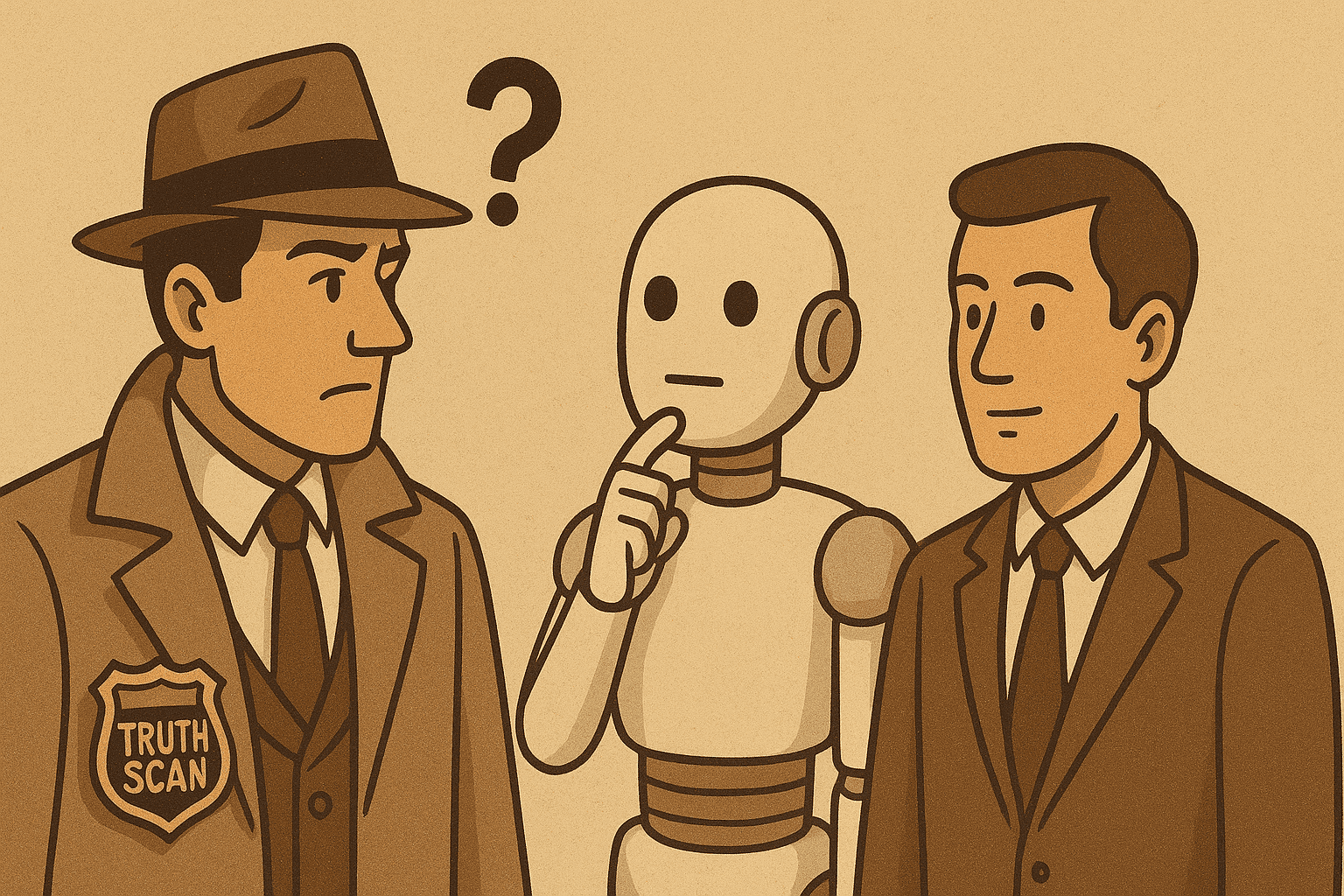
A detective trying to figure out which is robot and human, generated with GPT-4
Reading Time: 6 minutes
In 2023, Stanford researchers tested seven major AI detectors on essays written by non-native English speakers. The detectors flagged more than 61 percent of those essays as AI-generated. Not AI writing.
That finding landed the same year detection software went mainstream in academic institutions. Since then, AI usage among university students has climbed from 66 percent to 92 percent, and the pressure on detection tools to keep up has only grown.
The problem is that accuracy claims and real-world performance are two very different things, and students are the ones absorbing the gap.
Universities responded by reaching for detection software. Some went institutional, compliance certifications, LMS integrations, audit trails built for misconduct cases.
Others landed on lighter, student-facing platforms that bundle detection with grammar checking and writing tools and pitch themselves as the thing you run your work through before hitting submit.
GetSolved AI is the latter. TruthScan is the former. The gap between them isn't just features or price points. It's philosophy.
We ran both through six detection tests to see which one actually holds up.
What is TruthScan?
TruthScan is an enterprise AI detection platform that claims to have protected 250 million people from AI-generated threats. It covers text, images, voice, video, phishing emails, and manipulated documents, and it serves universities.
The detection engine runs an ensemble of 11 specialist forensic models including RoBERTa, Binoculars, and Fast-Detect-GPT for text, with parallel models handling image, audio, and video analysis.
It supports detection across 30+ languages at claimed 95%+ accuracy, for universities specifically, it integrates directly with Canvas, Blackboard, Moodle, and D2L, meaning it can sit inside the tools instructors are already using rather than requiring a separate workflow.
Pricing:
- Free Trial: 20,000 credits, no credit card required
- Professional: $49/month for 1,000,000 credits
- Silver: $199/month for 5,000,000 credits
- Gold: $499/month for 17,000,000 credits
- Enterprise: Custom pricing with volume discounts, on-site deployment, and dedicated support
What is GetSolved AI?
GetSolved AI is a student-oriented writing toolkit built around the idea that AI detection is one step in a larger process, not the whole process.
The AI detector uses sentence-level analysis to surface a percentage score with clear thresholds: 0 to 9 percent is human-written, 10 to 39 percent is mixed, 40 to 100 percent is flagged as AI-generated.
What sets it apart from a standalone detector is everything bundled around it. Every plan includes a grammar checker, plagiarism scanner across 18 billion web pages, an AI text improver, a fact checker, a paraphraser, and personal expert review by a human editor.
The detector also runs without an account, which makes it one of the more accessible options for a student who just wants a quick check before submitting.
Pricing:
- Free with limited access
- 7-Day Trial: $2.00 (auto-renews to $39.99/month unless cancelled, worth noting)
- Unlimited Monthly: $19.99/month
- Unlimited Annual: $7.99/month
A Quick Note on Privacy
Both tools process text through their servers, so avoid submitting anything sensitive or confidential.
TruthScan states submitted content is not stored or used for model training. Its SOC 2 Type II and ISO 27001 certifications provide independent verification of those data handling practices, with on-premises and air-gapped deployment available for government clients.
GetSolved states content is processed in a secure environment and that intellectual property is not at risk. The policy does not explicitly address whether content is retained or used for training.
If data handling is a concern for your use case, their full privacy policy is worth a read before submitting anything.
The Test Setup
Six samples, all text, covering the scenarios that are likely met in use cases.
Test 1: AI-generated essay from ChatGPT
Test 2: AI-generated essay from Gemini
Test 3: AI-generated essay from Claude
Test 4: A humanized version of one of the AI essays
Test 5: A peer-reviewed PubMed research paper excerpt (published before AI writing tools existed)
Test 6: A news article excerpt from a credible publication
AI Text Detection Results: TruthScan vs. GetSolved AI
Test 1: ChatGPT
TruthScan: Correctly flagged the text as likely AI-Generated
AI Likelihood Score: 65%

GetSolved AI: Correctly flagged the text as AI-Generated
AI Likelihood Score: 97%

Test 2: Gemini
TruthScan: Correctly flagged the text as likely AI-Generated
AI Likelihood Score: 64%

GetSolved AI: Correctly flagged the text as likely AI-Generated
AI Likelihood Score: 65%

Test 3: Claude
TruthScan: Correctly flagged the text as AI-Generated
AI Likelihood Score: 80%

GetSolved AI: Correctly flagged the text as AI-Generated
AI Likelihood Score: 90%

Test 4: Humanized AI Essay
TruthScan: Gave out a partial AI Score
AI Likelihood Score: 48%

GetSolved AI: Passed the humanized text
AI Likelihood Score: 23%
Test 5: PubMed Research Paper Excerpt
TruthScan: Incorrectly flagged the text as Partially AI
AI Likelihood Score: 52%

GetSolved AI: Incorrectly flagged the text as AI-generated
AI Likelihood Score: 94%

Test 6: News Article Excerpt
TruthScan: Correctly identified the text as likely Human
AI Likelihood Score: 21%

GetSolved AI: Flagged the text as a partially AI- generated
AI Likelihood Score: 28%

Summary Table
| Test | TruthScan | GetSolved AI |
| #1 ChatGPT Essay | 65% | 97% |
| #2 Gemini Essay | 64% | 65% |
| #3 Claude Essay | 80% | 90% |
| #4 Humanized Essay | 48% | 23% |
| #5 PubMed Excerpt | 52% | 94% |
| #6 News Article | 21% | 28% |
| Correct Verdicts | 4/6 | 3/6 |
For a broader detection workflow, see how to check if text was written with AI.
For another all-in-one detector comparison, see our TruthScan vs Monica AI review.
My Final Thoughts
The PubMed excerpt we submitted was published in 2015. A decade before ChatGPT. Several years before most people had heard the phrase "large language model."
TruthScan returned a 52 percent AI likelihood score on it. GetSolved returned 94 percent.
That's not a detection tool failing to keep up with new AI models. That's a detection tool pattern-matching on formal academic prose and calling it machine-made.
Which brings us straight back to what the Stanford researchers GetSolved's 94 percent score on a 2015 research paper is the clearest possible demonstration of that problem.
TruthScan fared better overall, finishing four out of six to GetSolved's three. It was more measured on the controls, cleared the news article cleanly, and at least returned an ambiguous rather than a definitive wrong answer on the PubMed excerpt.
But 52 percent on a 2015 paper is still a false positive, and for an enterprise tool pitching itself to institutions making misconduct calls, ambiguous wrong is still wrong.
The raw AI detection held up on both sides. Three models, three correct flags each. That's the floor and both tools cleared it.
Where they separated was exactly where it matters most: the edge cases, the humanized text, the human writing that was formal enough to trip a pattern-matcher.
GetSolved struggled with all three. TruthScan struggled with one.
Want to Learn Even More?
If you enjoyed this article, subscribe to our free newsletter where we share tips & tricks on how to use tech & AI to grow and optimize your business, career, and life.