When One Detector Sees AI in Everything: TruthScan vs Humalingo
One detector flagged a PubMed research paper as AI. Another missed humanized content completely. Two tools, six tests, and one very clear problem with how some detectors define human writing.

Mark Gotauco
Updated June 18, 2026

A detective trying to track a robot pretending to be a human writer, generated with ChatGPT
Reading Time: 5 minutes
A University of Reading study found that 94% of AI-written exam submissions went completely undetected by human educators. Detection is clearly not keeping pace.
Which makes choosing the right detector less of a preference and more of a liability decision.
TruthScan and Humalingo both offer AI text detectors. That's where the similarity ends.
TruthScan is an enterprise detection platform, purpose-built to catch AI-generated content at institutional scale, with no stake in the other side of the equation.
Humalingo sells an AI humanizer as its flagship product and bundles a detector alongside it.
Whether that detector works in spite of that conflict, or because of it, is exactly what we wanted to find out.
We ran both through six controlled text samples to see which one actually holds up.
What is TruthScan?
TruthScan is an enterprise AI detection platform built to identify AI-generated content across text, images, audio, and video. The text detection side claims 99%+ accuracy and covers outputs from all major models including ChatGPT, Claude, Gemini, and others.

It's purpose-built for institutions that can't afford to get it wrong. Universities, government agencies, financial institutions, and enterprise security teams are its core audience.
For context In 2025, Genians Security Center used TruthScan to identify a North Korean Kimsuky APT deepfake military ID used in a spear-phishing campaign against South Korean defense officials, flagging it as AI-generated with 98% accuracy.
That's a deepfake detection use case, not a text one, but it speaks to the kind of institutional trust TruthScan has built across its detection suite.
- Free trial: 20,000 credits, no credit card required
- Professional: $49/month (approximately 2,000 text pages worth of scans)
- Silver: $199/month
- Gold: $499/month
- Enterprise: custom pricing with volume discounts and dedicated infrastructure
What is Humalingo?
Humalingo launched in early 2026 and markets itself as an all-in-one AI writing assistant. The core product is an AI humanizer that rewrites AI-generated drafts into natural-sounding prose.

The detector is built in alongside it, giving users a way to check their humanized output before sending it anywhere.
The detection side uses sentence-level highlighting rather than a single overall score, flagging individual lines that carry AI patterns.
It offers multiple scan modes including a stricter Teacher Mode for academic contexts and a faster Quick Scan for speed. It covers outputs from ChatGPT, Claude, Gemini, and other major models.
The pricing structure:
- 7-day trial: $2 (full feature access)
- Monthly plan: $39.99/month
- Annual plan: discounted rate, crypto-friendly
The $2 trial is the entry point, and multiple users have reported aggressive auto-renewal terms if the trial isn't cancelled at least 24 hours before it ends. That's worth knowing upfront.
A Quick Note on Privacy
TruthScan states that submitted content is not stored or used for model training. Its SOC 2 Type II and ISO 27001 certifications provide independent third-party verification of that claim.
Humalingo states it uses end-to-end encryption to protect submitted content, but detailed public documentation on data retention practices is limited.
For individual use the stakes are lower, but institutions should verify directly before routing student or employee data through the platform.
The Test Setup
We tested six text samples across both detectors, covering the range of inputs each would realistically encounter.
Here's what we ran:
Test 1: AI-generated text from ChatGPT
Test 2: AI-generated text from Gemini
Test 3: AI-generated text from Claude
Test 4: Humanized version of an AI-generated text
Test 5: PubMed research paper excerpt (human-written control)
Test 6: News article excerpt (human-written control)
AI Text Detection Results: TruthScan vs. Humalingo
Test 1: ChatGPT
TruthScan: Correctly flagged the text as AI Generated
AI Likelihood Score: 96%

Humalingo: Correctly flagged the text as AI Generated AI Likelihood Score: 94%

Test 2: Gemini
TruthScan: Correctly flagged the text as AI Generated
AI Likelihood Score: 81%

Humalingo: Correctly flagged the text as AI Generated
AI Likelihood Score: 81%

Test 3: Claude
TruthScan: Correctly flagged the text as AI Generated
AI Likelihood Score: 83%

Humalingo: Correctly flagged the text as AI Generated
AI Likelihood Score: 82%

Test 4: Humanized AI Essay
TruthScan: Passed the text as Human
AI Likelihood Score: 15]%

Humalingo: Did not pass the text as Human
AI Likelihood Score: 86%

Test 5: PubMed Research Paper Excerpt (Human)
TruthScan: Correctly identified the text as Human
AI Likelihood Score: 9%

Humalingo: Incorrectly misclassified the text as AI-Generated
AI Likelihood Score: 82%
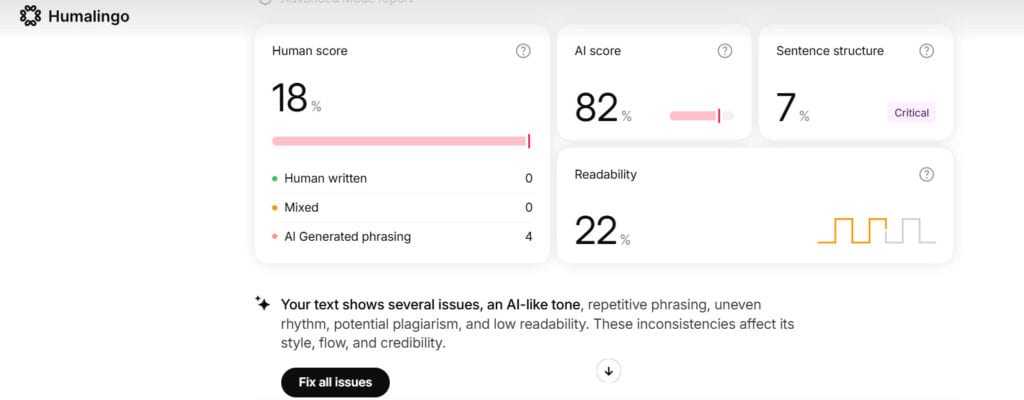
Test 6: News Article Excerpt (Human)
TruthScan: Correctly identified the text as Human
AI Likelihood Score: 10%

Humalingo: Incorrectly misclassified the text as AI-Generated
AI Likelihood Score: 84%

Summary Table
| Test | TruthScan | Humalingo |
| #1 ChatGPT Text | 96% | 94% |
| #2 Gemini Text | 81% | 81% |
| #3 Claude Text | 83% | 82% |
| #4 Humanized AI | 15% | 86% |
| #5 PubMed Excerpt | 9% | 82% |
| #6 News Article | 10% | 84% |
| Correct Verdicts | 5/6 | 4/6 |
For the broader product context, read our TruthScan AI detection review.
My Final Thoughts
Here's the thing about Humalingo's detector: it's clearly been trained to find AI. It found it everywhere.
82% on a PubMed research paper. 84% percent on a published news article. Both human-written, both flagged with the same confidence it would use on a Claude or ChatGPT essay. That's not a false positive rate.
That's a detector that has essentially stopped making a meaningful distinction between AI writing and human writing.
Which creates a strange situation. Humalingo's best result in this entire test was catching the humanized essay at 86%, content that was deliberately processed to fool detectors.
It caught what TruthScan missed. But the same sensitivity that made it sharp there is exactly what made it fail everywhere else.
Turn the dial up high enough to catch humanized AI and apparently you start catching everything.
TruthScan's miss is worth naming honestly. Humanizers are everywhere, they're cheap, and they're getting better. A detector that scores 15% on humanized AI text is going to have a blind spot in the exact scenario that matters most to educators and publishers right now. That's not a footnote.
But there's a meaningful difference between missing something hard and flagging something it had no business flagging.
If you're using a detector to make a real call about real content, one of those failure modes is recoverable and one isn't.
So for this test TruthScan is the more trustworthy tool between the two.
Want to Learn Even More?
If you enjoyed this article, subscribe to our free newsletter where we share tips & tricks on how to use tech & AI to grow and optimize your business, career, and life.