How to Bypass Turnitin AI Detection & Humanize ChatGPT
ChatGPT is one of the coolest things I've ever seen. But with its popularity came a bunch of issues, like deciphering AI-generated writing from human writing. It's also expanded into education, with tools like TurnItIn sometimes even falsely flagging students when they haven't used AI. Here's some good ways of rearranging your writing to avoid TurnItIn's AI detector

Justin Gluska
Updated June 17, 2026
a cute robot playing on the swings at recess in elementary school, 4k digital art
Reading Time: 9 minutes
🚨DISCLAIMER: The following content is for educational purposes only and not to be used for any unethical or illegal activities. Do not use these tools to submit work that violates your school, publisher, or workplace AI policy. Using tools or methods to bypass plagiarism or originality checks such as Turnitin can have serious academic consequences and is against the values of academic integrity. Please don't cheat! 🚨
Before submitting school or academic writing, use Undetectable AI to humanize the draft and reduce detection risk.
One of the biggest issues since the release of ChatGPT has been society questioning the differences between AI vs human writing. I mean, how do you even check if something was written with AI?
This became even more complicated for academic writing. Educational institutions rely on tools such as Turnitin to flag likely AI-generated content, but Turnitin itself says AI reports are decision-support signals, not final proof of misconduct, and false positives are possible.
For 2026, the important update is that Turnitin is not just looking for raw ChatGPT text. Its AI report can separate likely AI-generated writing from likely AI-generated writing that was modified with AI paraphrasing, word-spinner, or bypasser tools. That means you should treat humanizers as revision helpers, not guaranteed workarounds.
What Changed With Turnitin AI Detection?
| Turnitin detail | Why it matters |
|---|---|
| Submissions need 300 to 30,000 words of long-form prose | Short, non-prose, code, tables, and odd formats may not be evaluated the same way. |
| Supported AI-report languages include English, Spanish, and Japanese | Detection behavior can differ by language and model. |
| Scores from 1% to 19% are shown as *% instead of exact scores | Turnitin says low scores have a higher false-positive risk. |
| English reports can flag AI-paraphrased or AI-bypasser-modified text | Running ChatGPT output through a humanizer or QuillBot-style tool is not a guarantee. |
It's important to understand that avoiding AI detection is not synonymous with deception. The safer goal is making sure your final writing reflects real human thinking, accurate sources, and your own voice. Here are a few tools and workflows people use to revise AI-assisted writing, starting with the one I would test first:
1) Use Undetectable.AI
One of the best ways to change your writing in a matter of seconds is to use Undetectable AI. You simply enter your writing into the box, select any options you want customized, and sit back & let it do the work for you. Most articles get rewritten in about 10-60 seconds. Here's how it works:
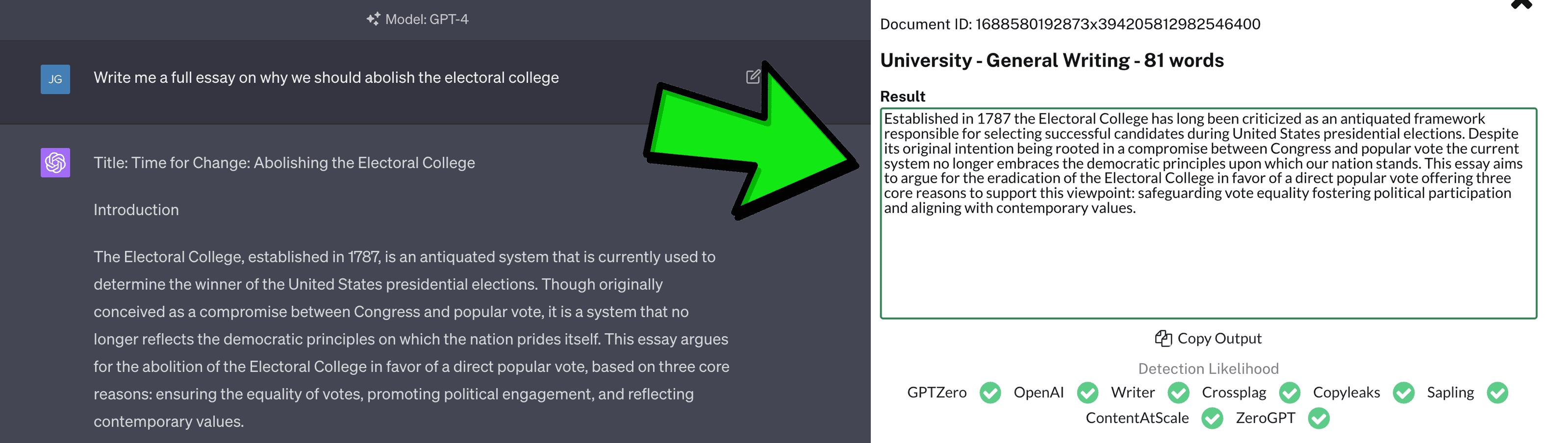
I took some ChatGPT text from an essay and put it directly into Undetectable. This one took about 15 seconds to make (I did only use the first paragraph though) and you'll be on your way.
Make sure to read these results though. Sometimes the scrambling/paraphrasing of the words make it a little funky. You can customize further details to change the output you get from UD:
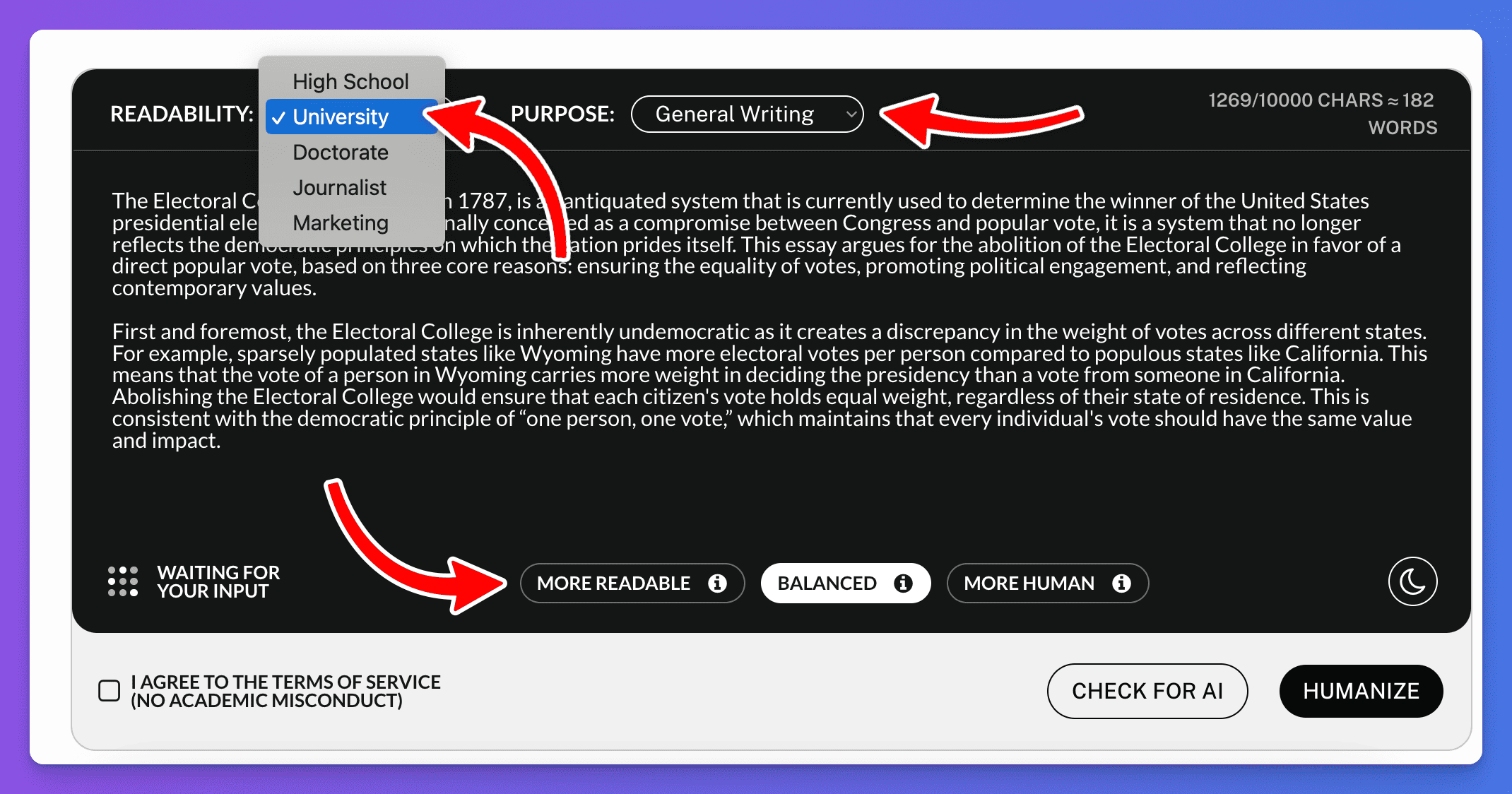
You can change the readability & purpose levels to really adapt to what you're looking for. If you want it to rephrase your content that reads well for a university essay, you can do it. You can also change the readability for marketing products. There's so many options to tweak things.
The bottom has 3 options showing you the spectrum of readable to human content. If you make it more readable, it will make a lot more sense but may still look more AI-like to some detectors. If you set it to more human, it may reduce detector risk, but it can also introduce weird formatting, grammar issues, or phrasing that still needs a manual edit.
Balanced might seem like the best of both worlds, but in my experience, it can land in an awkward middle: not polished enough to submit untouched and not different enough to rely on as a detector-risk fix.
Isn't that kind of a weird paradox we're getting into...?
We have a full review on Undetectable if you want to learn about the intricacies of how it works & what you could get out of it, but this is definitely the best start.
2) Hide It & Paraphrase With HideMyAI
I am particularly fond of HideMyAI due to how many options you can change and customize. In the span of mere seconds, you'll turn AI-generated content into human writing.
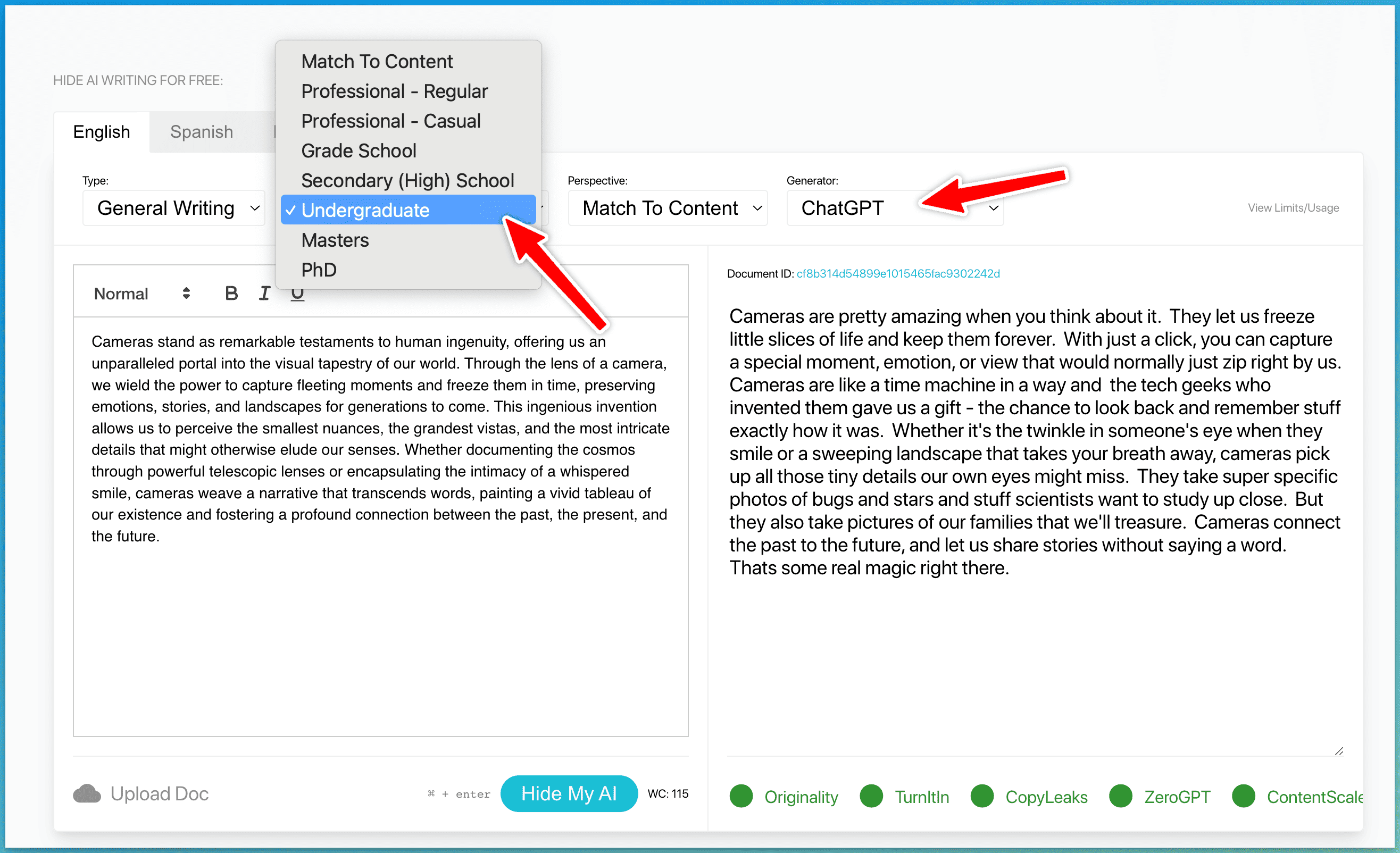
The tool currently lists multilingual support for English, Spanish, Russian, and French. I would still test the exact language and assignment type you care about before trusting any one rewrite.
In my experience though, while the difference isn’t exactly stark, Undetectable AI performs better than HideMyAI both in hiding from AI detection and readability. That said, the latter is just a teeny-tiny bit cheaper than the former, but not to the point that it matters really.
3) Paraphrase with QuillBot
The third thing you could do is paraphrase your sentences with QuillBot. You could do this either after you run the writing through Undetectable or right after you use ChatGPT.
It's not as perfect but it also gives you 100% customization to change your writing because it lets you swap out synonyms and sentence structures. Check this out:
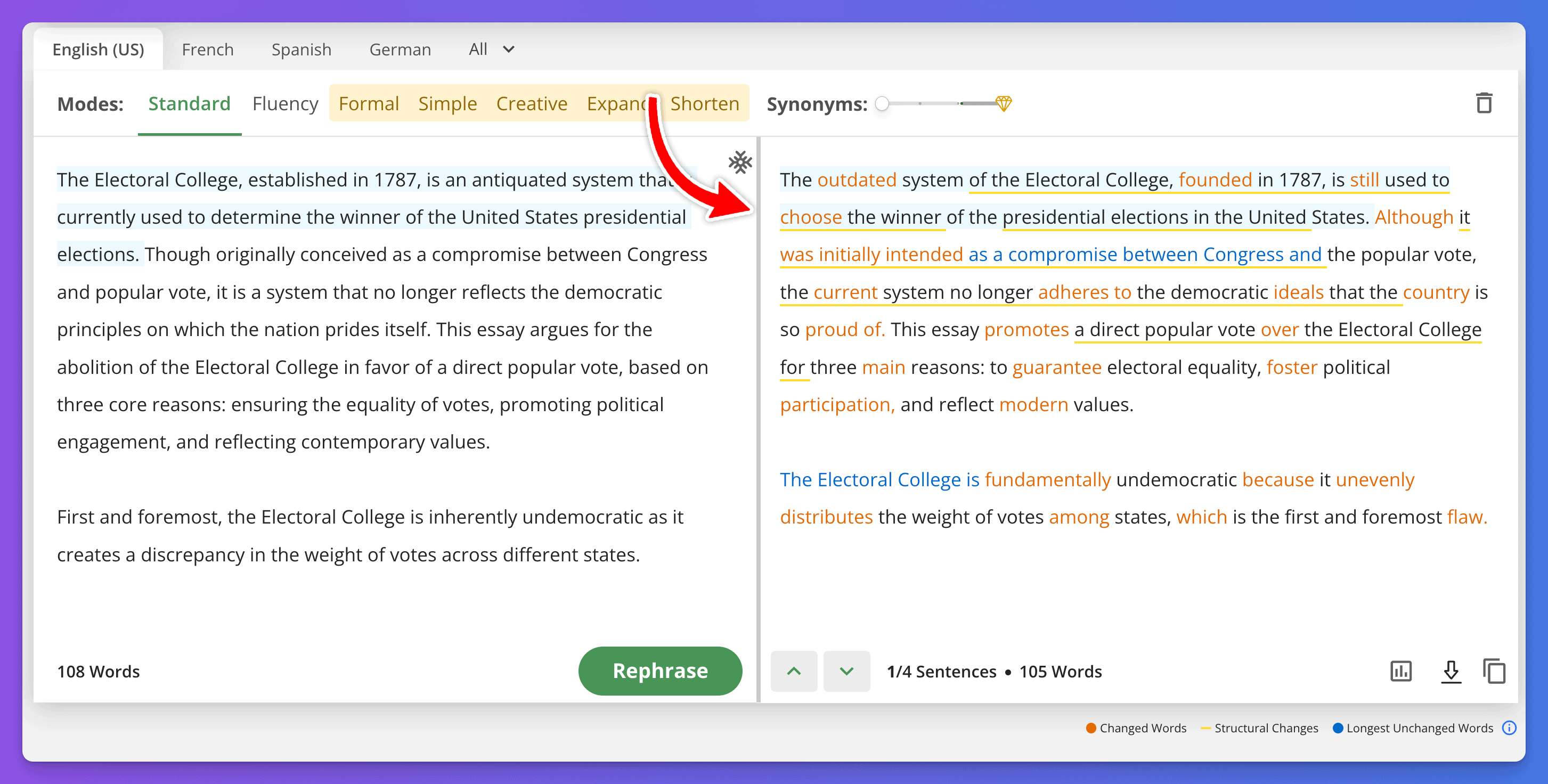
You can click on the orange, blue, or really any sentences and you'll get a box that lets you swap out sentences. Just make sure what you're changing actually makes sense!
I've noticed QuillBot can be really good for short-form content, but after a while (especially on longer essays) it really just tries to change everything and completely funks out the entire paper. Just be leery of this.
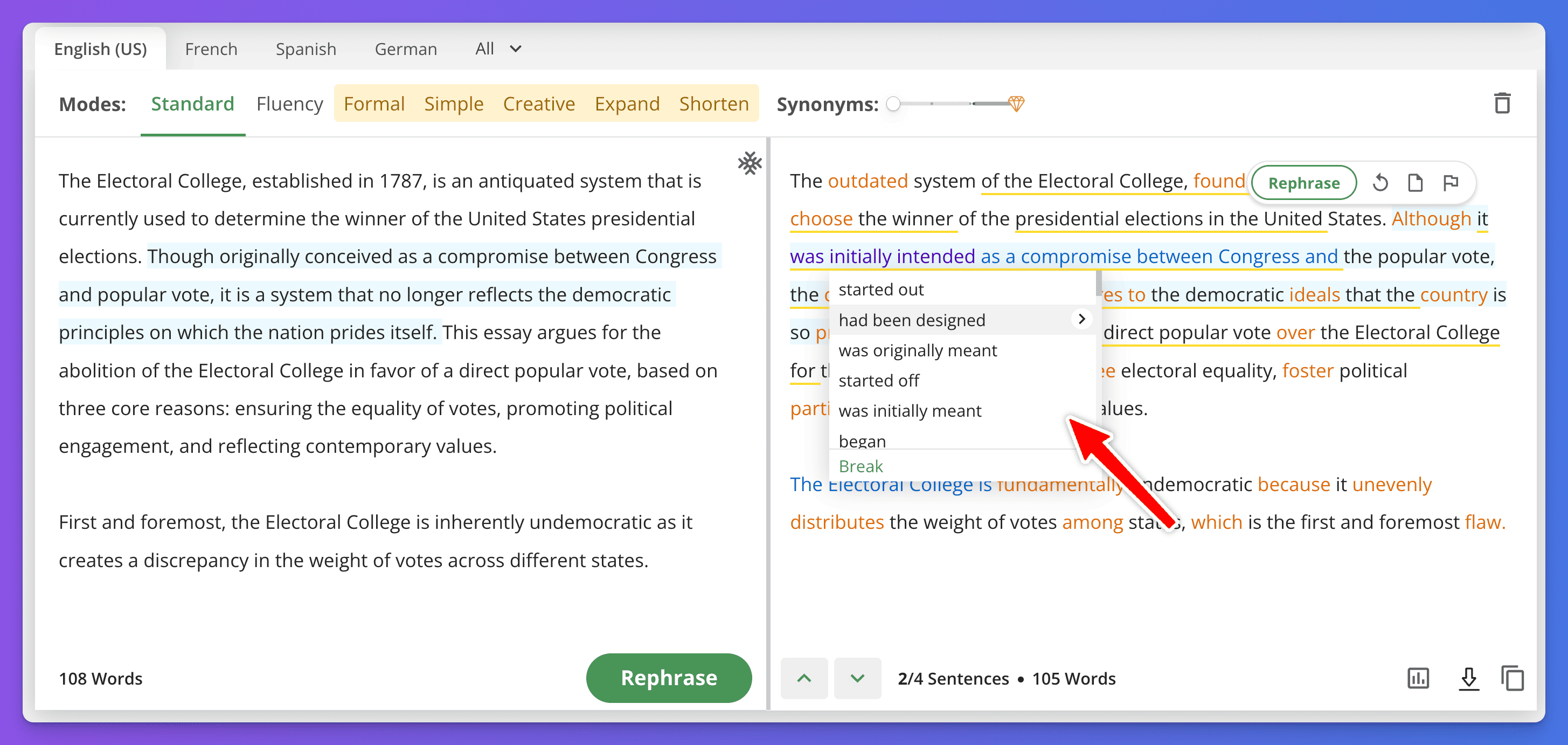
The issue with QuillBot is that it is primarily a writing and paraphrasing tool, not a guaranteed Turnitin workaround. Turnitin now explicitly describes AI-paraphrased writing as something its report can flag in English submissions, including text modified by tools such as QuillBot. Use it to improve clarity, then revise the output yourself.
After you're done revising, you can save or copy the new text and put it into wherever you were originally editing. QuillBot is pretty awesome!
4) NetusAI
Similar to the other tools, Netus markets rewriting tools that claim to help with Turnitin and other detectors. I would treat that as a vendor claim unless you retest it with the exact kind of writing you are working on. It doesn't seem to work as well (or in-depth) as Undetectable and HideMyAI, but it is still one of the better-known bypass-style tools.
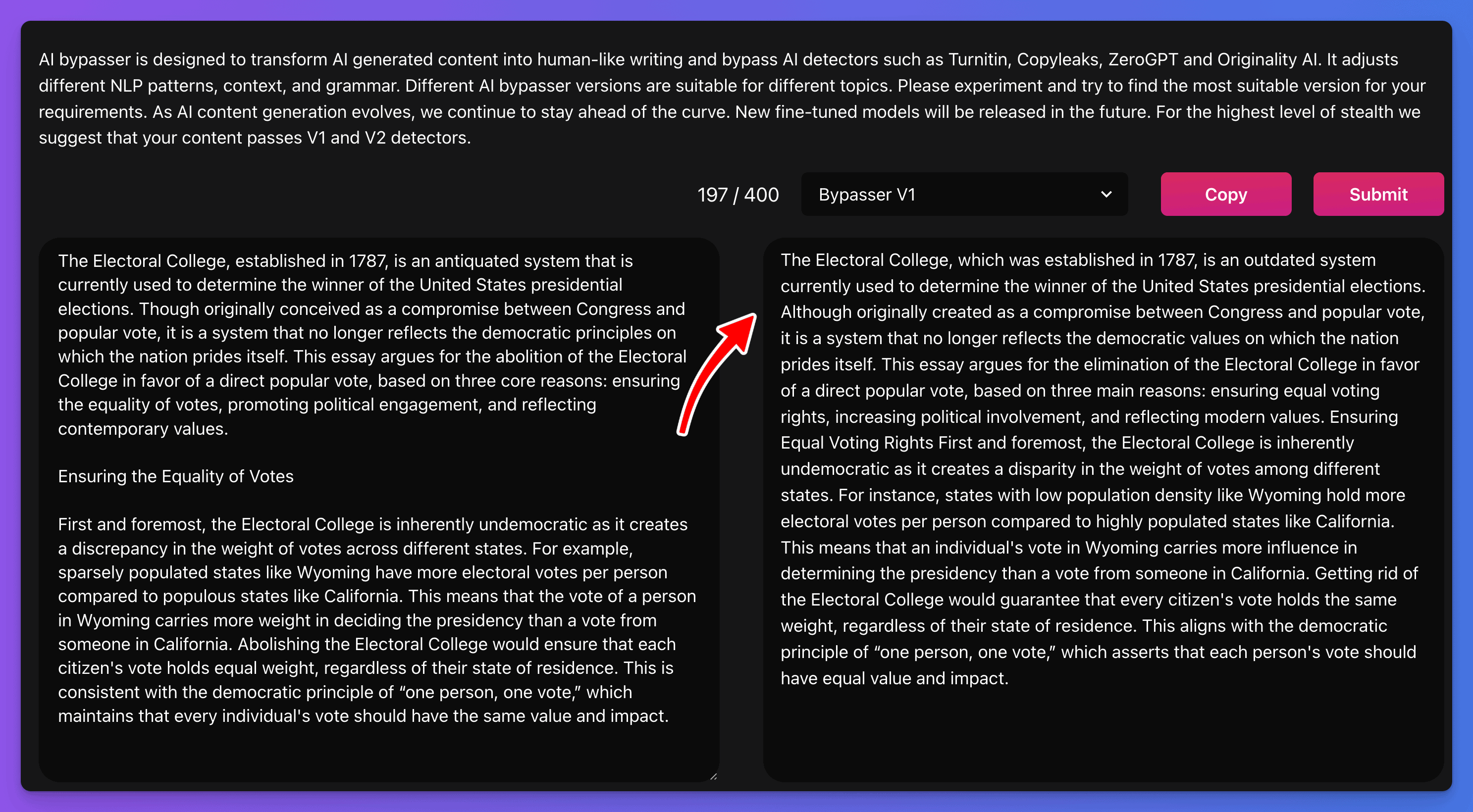
5) Humbot
Here’s one last AI bypassing tool: Humbot.
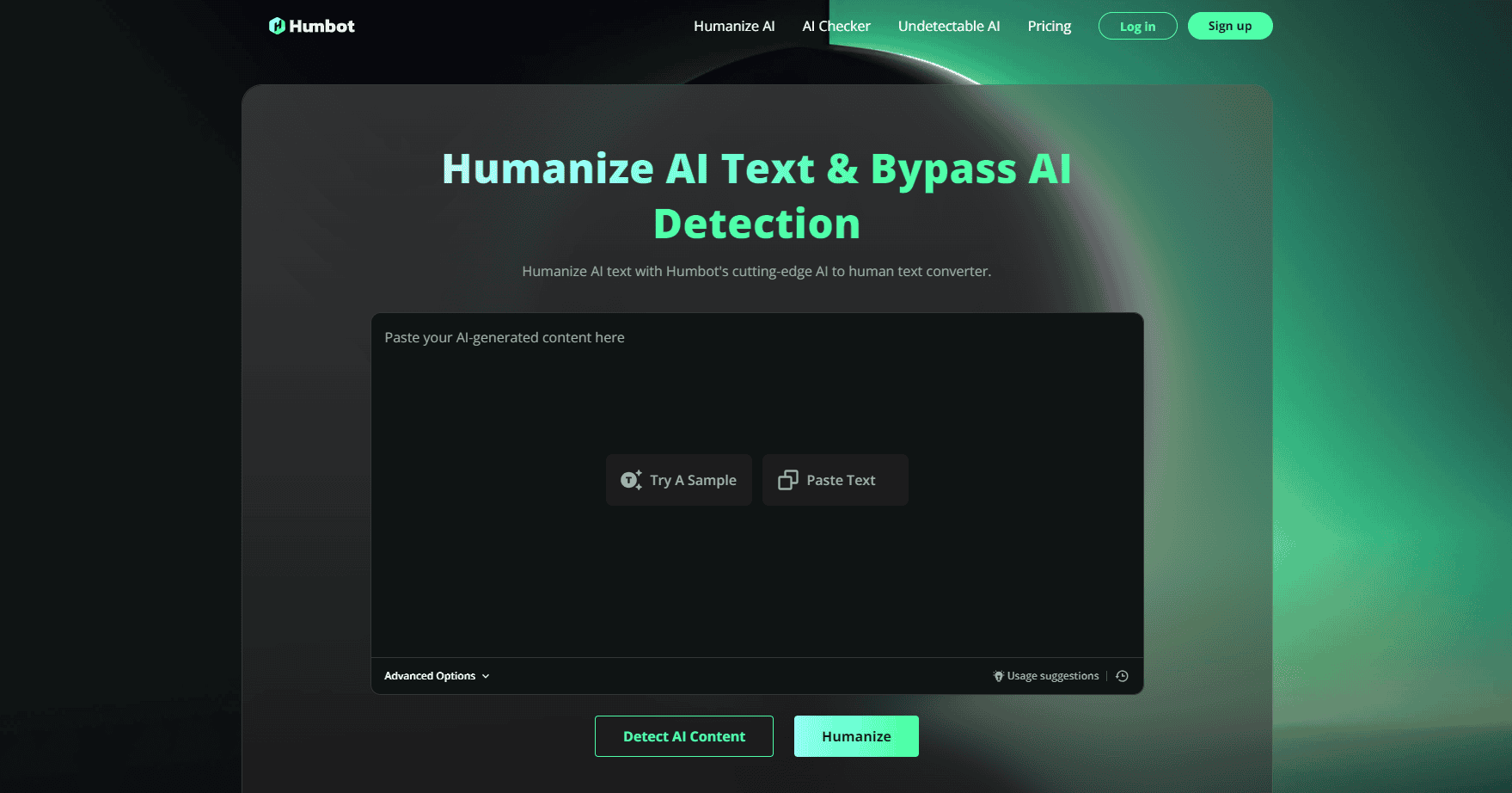
Like the others I mentioned earlier, it works by removing common AI structure and words to make your text appear more human. One thing that both Undetectable AI and HideMyAI has over Humbot is that they both have output customization features (different use cases, readability) while the latter does not.
I will say though that, in my experience, Humbot generally makes more readable text than its counterparts. The issue is that it also hallucinates a lot more than them. This issue stems from its tendency to add proper nouns to sentences, even if they don’t make sense, just to avoid AI detection.
If they can find a way to limit hallucinations, then Humbot would be my first pick along with Undetectable AI as far as AI humanizers are concerned. But for now, it’s a good third or fourth option.
6) Actually Revise Your Writing
I know this one sounds obvious, but actually revising the ChatGPT output can do wonders. While most of the AI detection software is able to tell when you change a few words here or there, you can really just use ChatGPT as a blueprint to write what you actually want to talk about.
While it's not always the most factually accurate, I've realized how great of an outline/planner it is for drafting headline, subsections, and paragraph topics. This is the healthiest middle ground: use AI for brainstorming, then expand, source, and write the actual argument yourself.
This also gives you process evidence if a teacher or editor questions the work. Keep notes, outlines, source links, version history, and drafts. Turnitin's newer product direction is increasingly about process, not just a final AI percentage.
If you already have AI writing, here’s what you should remove or rewrite to humanize your text:
- Repetitions.
- Over-reliance on both running lists and bullet points.
- Too many adverbs and transition words.
- Common AI words like “utilize”, “revolutionize”, “crucial,” and more.
There's nothing better than using ChatGPT in the way it was meant — to supplement your life. Many of us (myself included) often try to just create articles or essays with it and it just doesn't work that well. Unless you really figure out how to fine tune the article, you'll be left with something so "perfect" it doesn't make sense at all.
For more Turnitin-specific testing, see whether Undetectable AI can still bypass Turnitin and our Undetectable AI vs Turnitin humanizer test. For broader context, read our notes on Turnitin AI detection concerns and why AI detection is too unreliable for classrooms.
Final Thoughts
While I don't necessarily agree with what all of these AI detection companies are doing, I get their point. You should not be using ChatGPT to do anything illegal, unethical, or against your school's policy. And in 2026, I would not assume that rewriting or paraphrasing alone is enough to avoid Turnitin or any other serious AI writing detector.
Detection and bypass tools are in an arms race. The safer route is transparent, policy-compliant AI use plus real revision: understand the topic, cite your sources, edit the wording, keep drafts, and make the final piece sound like something you can actually explain.
We already released the beast of AI into the world with ChatGPT and it's basically impossible to turn back now. We're in for a very interesting next few years... especially with the disruption of education that's pretty rapidly approaching. Let me know your thoughts below!
Want to Learn Even More?
If you enjoyed this article, subscribe to our free newsletter where we share tips & tricks on how to use tech & AI to grow and optimize your business, career, and life.