Can These Free AI Image Detectors Catch Fakes? ImageDetector vs EyeSift
At this point, asking a human to spot an AI-generated image is like asking them to call a coin toss. We tested two free detectors to see which one could do what your eyes no longer can.

Mark Gotauco
Updated June 18, 2026
Reading Time: 6 minutes
According to a 2025 study by Conjointly, consumers correctly identified AI-generated images only 52% of the time. That's barely better than a coin flip.
Let that sit for a second.
You have roughly the same odds of spotting a fake image as you do calling heads on a coin toss. And that number has been hovering near 50% since 2023, even as AI image generators have gotten dramatically better.
Fake profile photos anchor scam accounts. AI-generated receipts get submitted as payment proof. Synthetic faces pass identity verification checks. And in almost every case, the person on the receiving end had no idea.
That's where AI Image detection tools come in. Not as final verdicts, but as a first line of defense. A way to flag what deserves a second look before a decision gets made.
ImageDetector and EyeSift are two of the more accessible options right now. Both are free. We ran six images through each of them to find out which one actually holds up.
What is ImageDetector?
ImageDetector is a free AI image detection tool built for speed and accessibility. No account required, no paywall, no credit system. Upload an image and get a result in seconds.

The detection engine analyzes visual signals directly in the image itself, specifically texture patterns, noise behavior, and structural details.
It does not rely on watermarks or metadata to reach a verdict, which matters when dealing with images that have been compressed, shared, or re-saved multiple times before you ever see them.
It's model-agnostic by design, built to detect outputs from a broad range of generators including ChatGPT, Gemini, Midjourney, Stable Diffusion, Ideogram, Flux, and Bing Image Creator.
Pricing:
- Free with no account required
- Enterprise-grade API available for high-volume use cases
What is EyeSift?
EyeSift is a free, browser-first detection platform covering text, images, video, and audio under one roof, with no signup required.

It offers 25 free tools spanning AI detection, writing checks, and text utilities, making it one of the more complete free options available right now.
Its image detector takes a multi-signal approach. Rather than relying on visual patterns alone, EyeSift layers in metadata analysis: EXIF data, C2PA/Content Credentials, compression artifacts, and pixel patterns.
Real photographs from cameras carry rich EXIF data including camera model, lens settings, GPS coordinates, and timestamps. AI-generated images typically lack this entirely or carry generic placeholder values.
The C2PA check adds another layer, flagging whether an image carries verifiable content credentials from its source.
One thing EyeSift is explicit about: it's a screening tool, not a forensic verdict. That's an honest position, and it's the right framing for how these tools should be used.
Pricing:
- No paid tiers
- No account required
A Quick Note on Privacy
Both tools process uploaded images through their systems, so avoid uploading anything sensitive, proprietary, or anything you wouldn't want passing through a third-party platform.
EyeSift is explicit about browser-side processing, meaning analysis happens locally in your browser rather than on their servers.
ImageDetector states that images are processed securely and stored in accordance with their privacy policy, but does not provide a public-facing data retention timeline.
If you're working with identifiable subjects, unreleased visuals, or anything confidential, factor that in before you upload.
The Test Setup
Six images. Three synthetic, three real. The goal was to cover the full range of what these tools actually encounter in the wild, not just the easy cases.
Test 1: ChatGPT-generated image
Test 2: Gemini-generated image (Nano Banana)
Test 3: Midjourney-generated image
Test 4: A genuine photograph taken on a smartphone camera..
Test 5: A real photograph with post-processing applied, color grading, retouching, or cropping.
Test 6: An image sourced directly from a social media post.
The first three tests establish baseline detection on known synthetic images. The last three are the real stress test.
AI Image Detection Results: ImageDetector vs. EyeSift
Test #1: ChatGPT Image
ImageDetector: Correctly flagged the image as AI Generated
AI Likelihood Score: 99%

EyeSift: Correctly flagged the image as AI Generated
AI Likelihood Score: 77%

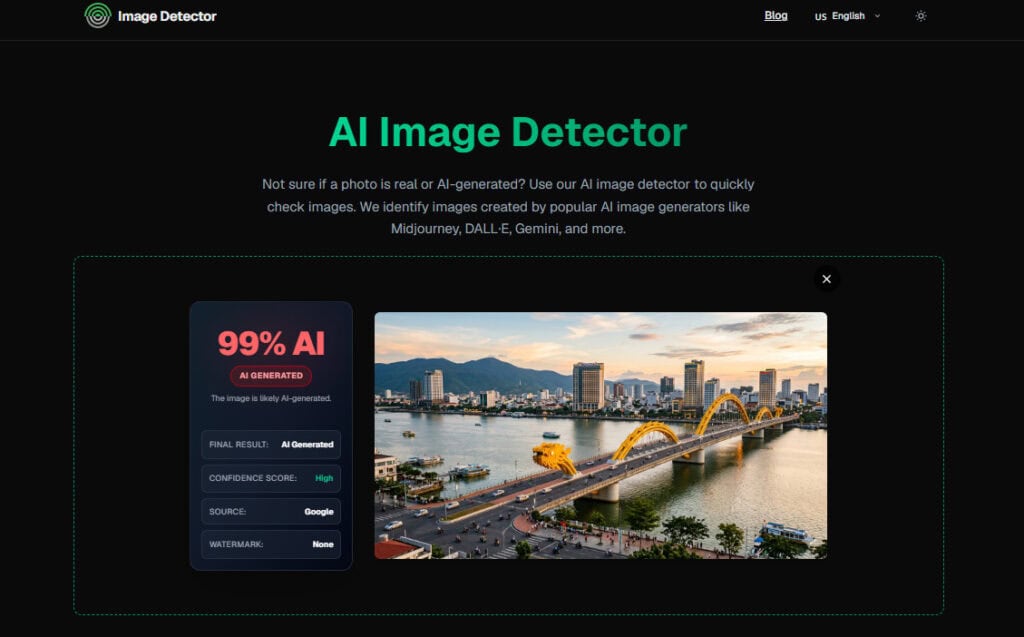
Test #2: Gemini Image
ImageDetector: Correctly flagged the image as AI Generated
AI Likelihood Score: 99%
EyeSift: Did not give out a definite verdict
AI Likelihood Score: 45%

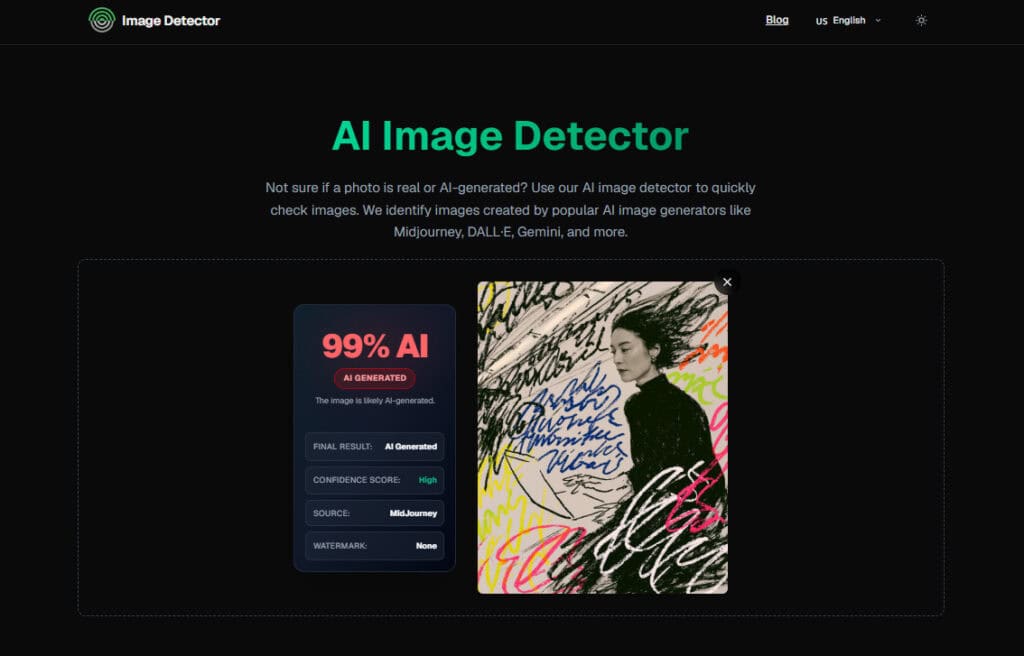
Test #3: Midjourney Image
ImageDetector: Correctly flagged the image as AI Generated
AI Likelihood Score: 99%
EyeSift: Incorrectly identified the image as Human
AI Likelihood Score: 27%

Test #4: Unedited Photo
ImageDetector: Correctly identified the image as Real just barely
AI Likelihood Score: 45%

EyeSift: Did not give out a definite verdict
AI Likelihood Score: 49%

Test #5: Edited Photo
ImageDetector: Flagged the image as AI generated
AI Likelihood Score: 56%

EyeSift: Did not give out a definite verdict
AI Likelihood Score: 49%

Test #6: Social Media Photo
ImageDetector: Correctly identified the image as Real
AI Likelihood Score: 15%

EyeSift: Did not give out a definite verdict AI Likelihood Score: 49%

Results Summary
| Test | ImageDetector | EyeSift |
| #1 ChatGPT Image | 99% | 77% |
| #2 Gemini Image | 99% | 45% (no verdict) |
| #3 Midjourney Image | 99% | 27% (incorrect) |
| #4 Real Photo | 45% | 49% (no verdict) |
| #5 Edited Photo | 56% (AI artifacts detected) | 49% (no verdict) |
| #6 Social Media Photo | 15% | 49% (no verdict) |
| Correct Verdicts | 5/6 | 1/6 |
My Final Thoughts
ImageDetector got five out of six right. It swept the AI-generated tests with 99% confidence across all three generators.. A lot of detectors can catch an obvious ChatGPT render. Far fewer return the same conviction on a Midjourney image, which is widely considered the hardest generator to flag.
ImageDetector did both with the same score.
The edited photo result deserves a closer look. ImageDetector flagged it as AI-generated at 56%, which on the surface reads as a false positive. It isn't. The photo had digital edits applied, and the tool was picking up on the artifacts left behind by that processing.
The AI-influenced portions of the image were detectable even after they were removed. That's not a mistake. That's the detector doing exactly what it's supposed to do.
The real photo and social media photo both came back correctly identified as human, though the unedited photo's 45% score was closer to the line than you'd want.
EyeSift's results tell a different story. It returned a definitive verdict on only two of the six tests. On the one test it got confidently wrong, Midjourney, it scored the image at 27% and called it human.
The remaining four tests all came back at 49%, which is essentially the tool refusing to commit..
EyeSift positions itself honestly as a screening tool rather than a verdict engine, and in some contexts that framing makes sense.
For anyone who needs a free, no-account image detector that actually commits to a call, ImageDetector is the clear pick from this test.
For another image-detection benchmark, see our Undetectable AI vs Sightengine comparison.
Want to Learn Even More?
If you enjoyed this article, subscribe to our free newsletter where we share tips & tricks on how to use tech & AI to grow and optimize your business, career, and life.