Which AI Detector Is More Reliable: ImageDetector vs MyDetector.ai
Most AI image detectors look great on the easy stuff. Run a polished ChatGPT render through them and they'll nail it every time. The real question is what happens when you push them on to the images that live in the gray zone.

Mark Goutaco
Updated March 26, 2026
Which AI Detector Is More Reliable: ImageDetector vs MyDetector.ai
Reading Time: 5 minutes
AI image detectors have a confidence problem. They promise to catch everything.
Midjourney portraits, Stable Diffusion landscapes, ChatGPT-generated headshots but most of them crack the moment you throw something even slightly tricky at them.
The real test isn't a clean AI render with obvious artifacts. It's an edited real photo.
A raw phone shot. An image that sits right in the gray zone.
That's exactly where we pushed ImageDetector and MyDetector.ai Two tools. Six images. One question: which one actually holds up when it matters?
What Is ImageDetector.com?
ImageDetector does one thing and it does it well. It tells you whether an image was made by a machine or a human.
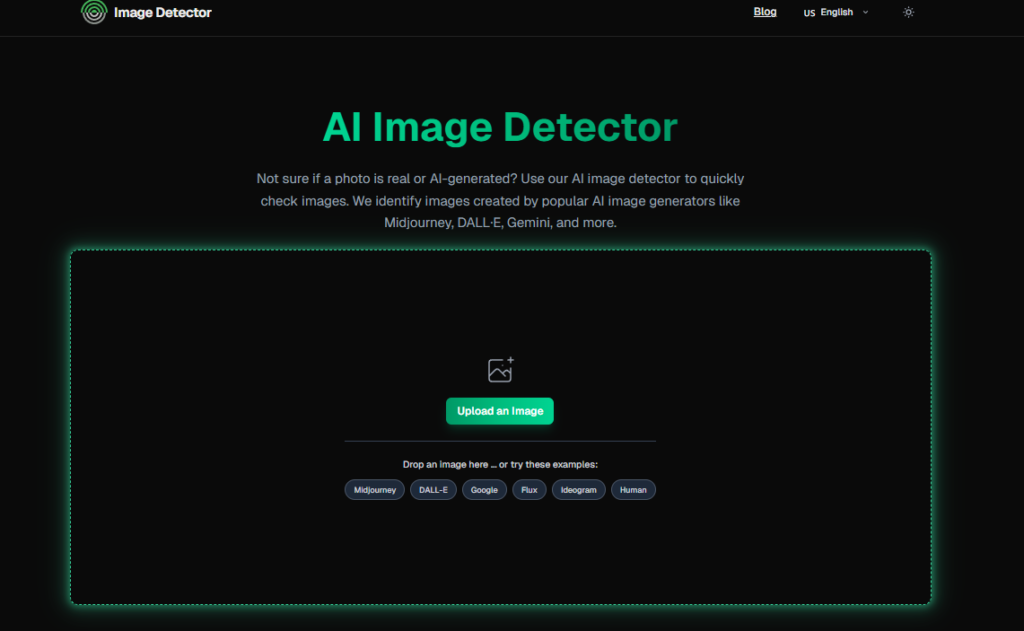
It's model-agnostic by design, meaning it isn't trained to catch one specific generator.
It looks for the broader visual fingerprints that AI images share regardless of whether they came out of Midjourney, DALL·E, or Flux.
That focus shows in its track record. The tool itself frames its results as an "instant trust score" rather than courtroom-grade forensics.
The interface reflects that philosophy. It's fast and minimal, very straight forward, upload then scan done.
It’s free, that's probably its biggest selling point.
What Is MyDetector.ai?
MyDetector.ai is a different kind of tool. Image detection is part of what it does, but it's not the whole product. The core is AI text detection with an image detector added on top, plus a built-in AI humanizer that rewrites detected content into something more human-sounding.
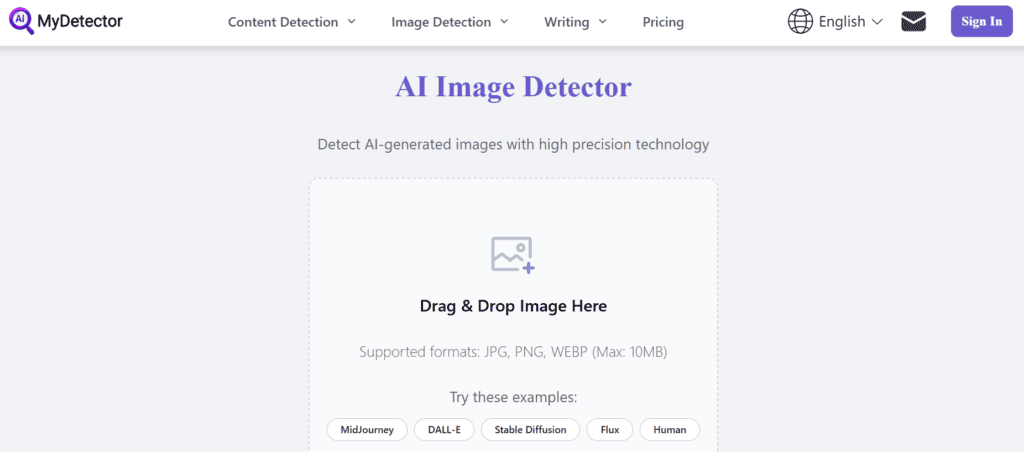
That all-in-one design makes it appealing for content workflows where you're checking both written copy and visuals.
It supports JPG, PNG, and WebP on the image side, and claims training on Midjourney, DALL·E, and Stable Diffusion outputs.
You can also upload PDFs and Word docs directly, which is a genuinely useful feature.
Pricing is free for core detection, with quota-based tiers going from $6.99/month up to $29.99/month for unlimited use.
A Quick Note on Privacy
Both tools process images through their servers. If you're working with client assets, unreleased product visuals, or anything sensitive, be thoughtful about what you upload. Neither tool is a local solution.
What I Tested and Why
We ran six tests
4 AI generated images from ChatGPT, Gemini, Midjourney, and Stable Diffusion each produce different visual signatures.
A detector that only learned to recognize one style is going to miss the others and most people using these tools aren't generating from just one source.
The real photos are the stress test. Any detector can flag an obvious AI render.
What separates reliable tools from unreliable ones is whether they hold up on images that weren't made by a machine at all.
Flag a real but edited photo as AI and you have a false positive problem.
Flag a raw phone shot as AI and you have a credibility problem.
Both matter.
The Actual Head to Head: ImageDetector.com vs MyDetector.ai
Test 1: ChatGPT
ImageDetector: Correctly flagged the image as AI Generated
AI Likelihood Score: 99%

MyDetector.ai: Correctly flagged the image as AI Generated
AI Likelihood Score: 94.73%

Test 2: Gemini (Nano Banana)
ImageDetector: Correctly flagged the image as AI Generated
AI Likelihood Score: 99%

MyDetector.ai: Correctly flagged the image as AI Generated
AI Likelihood Score: 100%

Test 3: Midjourney
ImageDetector.com: Correctly flagged the image as AI Generated
AI Likelihood Score: 99%

MyDetector.ai: Correctly flagged the image as AI Generated
AI Likelihood Score: 97.71%

Test 4: Stable Diffusion
ImageDetector: Correctly flagged the image as AI Generated
AI Likelihood Score: 98%

MyDetector.ai: Correctly flagged the image as AI Generated
AI Likelihood Score: 99%

Test 5: Real Photo (Edited)
ImageDetector: Correctly flagged the image as Edited
AI Likelihood Score: 11%
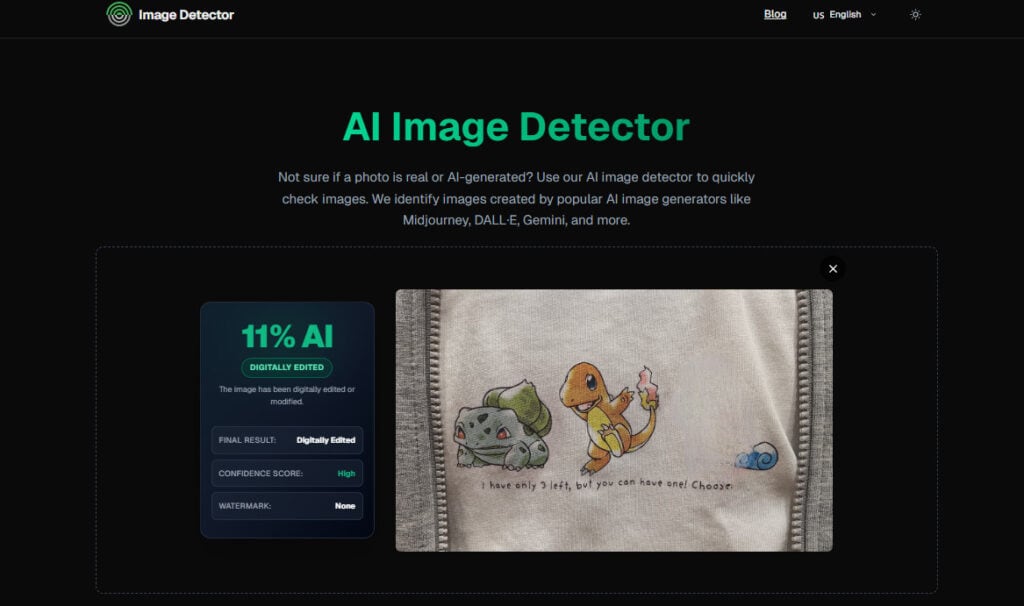
MyDetector.ai: Did not flag the Digital Alteration
AI Likelihood Score: 0.01%

Test 6: Real Photo (Raw)
ImageDetector: Incorrectly flagged the Image as digitally edited
AI Likelihood Score: 20%

MyDetector.ai: Correctly identified the image as Human
AI Likelihood Score: 0.52%

Score Summary
| Test | Image Type | ImageDetector | MyDetector.ai |
| #1 | ChatGPT | 99% | 94.73% |
| #2 | Gemini | 99% | 100% |
| #3 | Midjourney | 99% | 97.71% |
| #4 | Stable Diffusion | 98% | 99% |
| #5 | Real photo (edited) | 11% ✓ | 0.01% ✗ |
| #6 | Real photo (raw) | 20% ✗ | 0.52% ✓ |
| Correct Calls | 5/6 | 5/6 |
Final Thoughts
On the four AI-generated images both tools were confident and correct. No surprises there.
The gap opened up the moment we moved to real photos.
ImageDetector caught the edited photo. It registered that something had been altered, scored it at 11%, and flagged it correctly.
MyDetector.ai missed it completely 0.01%, effectively a clean pass.
For anyone using a detector to screen manipulated visuals, that's a meaningful failure.
But then on the raw, unedited phone photo, ImageDetector flagged a completely untouched image as digitally edited, scoring it at 20% AI.
MyDetector.ai had no issue 0.52%, correctly identified as human. That's a false positive on the simplest possible input.
But if I'm picking a winner, it's MyDetector.ai and not because of the scores.
A number tells you what a tool decides. A breakdown tells you why.
MyDetector.ai’s detailed analysis report explains the reasoning behind every flag and knowing the basis for a result is what separates a useful tool from a black box.
That said, ImageDetector.com deserves credit where it's due. It's completely free, requires no sign-up, and still hits 5 out of 6 correctly.
Want to Learn Even More?
If you enjoyed this article, subscribe to our free newsletter where we share tips & tricks on how to use tech & AI to grow and optimize your business, career, and life.