Which Humanizer Actually Beats AI Detection? Undetectable AI or Twixify
Six tests, three AI models, two humanizers, and a detector that doesn't care about either tool's marketing claims. Here's what actually happened.

Mark Gotauco
Updated June 18, 2026

Reading Time: 6 minutes
Raw ChatGPT outputs were easy to spot. Stiff sentence structure, em-dashes everywhere, a vocabulary that felt just slightly too formal for whoever supposedly wrote it.
Run your writing through Undetectable AI to see detection risk and clean it up before you submit or publish.
Students and writers figured this out early. Paste your ChatGPT essay into a humanizer, run the output through a detector, check the score, and if it's low enough, submit.
The workflow is now so standard that entire communities exist to compare which humanizers hold up against which detectors.
What used to be an edge case is now just how a lot of people use AI writing tools.
Two names keep coming up in those conversations: Undetectable AI and Twixify.
One is the established brand with the name recognition.
The other is the newer challenger making a different kind of pitch, less about raw bypass power, more about making AI text sound like you specifically wrote it.
We runned text from ChatGPT, Gemini, and Claude to these humanizers. Every output was checked against TruthScan. Here's what the numbers showed.
What is Undetectable AI?
Undetectable AI was introduced in 2023 and soon became a household name when it comes to making things sound human.
At its core, the product does two main things: it can spot content that was created by AI and it can rewrite that content to make it seem like it was written by a person.
The best part is that it does all this in one place, so you don't have to jump between different tabs to check your work.
The humanizer tool puts you in charge of how readable your text is and what it's for.
You can pick from settings like General, Essay, Email, and Marketing to make sure your rewrite fits what you're working on. There's also a "More Human" mode that really shakes things up and often gets the best results.
Higher-tier plans include API access, which makes it useful for agencies running large content volumes. The built-in detector covers outputs from GPT-4, Claude, Gemini, and other major models.
Pricing is word-based and scales with volume:
- Free trial: ~250 words
- 10,000 words/month: $9.99/month or $5.00/month billed annually
- 20,000 words/month: $19.00/month or $9.50/month billed annually
- 35,000 words/month: $31.00/month or $15.75/month billed annually
- 50,000+ words/month: Custom pricing available
- Business/Bulk: Custom pricing, non-expiring credits, white labeling, and priority support
All paid plans include: Unlimited AI detecting, unlimited Human Auto Typer, and API compatibility
Annual plans: 50% off across all tiers
What is Twixify?
Twixify is a newer entrant, but it's been picking up traction fast, particularly among solo creators and writers who want AI content that sounds like them rather than just content that sounds less robotic.
It's a standalone humanizer, nothing else. No built-in detector, no writing suite. You paste your text, pick your intention, and it rewrites. The differentiator is style mimicry.
You provide a writing sample, Twixify analyzes it across 17 writing properties, and rewrites your AI-generated text to match your tone, syntax, and structure. That's a meaningfully different approach from tools that apply a generic paraphrase and call it humanized.
It also offers writing intention presets tuned for SEO, academic writing, casual content, and other use cases, so the rewrite is calibrated to how the text will actually be used.
Pricing is request-based rather than word-based:
- Free tier: 150 words per run, 3 requests per day
- Basic: $8/month for 400 words per cycle, 75 monthly requests
- Standard: $13/month for 600 words per cycle, 150 monthly requests
- Premium: $27/month for 1,000 words per cycle, 200 monthly requests
A Quick Note on Privacy
Both tools process submitted text through their servers, so avoid uploading anything sensitive, confidential, or proprietary.
Undetectable AI does not publish a clear data retention or training policy in plain language on its site. If content ownership is a concern for your workflow, that's worth factoring in.
Twixify similarly doesn't publish an explicit data handling policy. Given that both tools are in the business of rewriting your text, it's reasonable to assume submitted content passes through their systems in some form.
The Test Setup
Six tests total. One AI-generated essay from each of the three major models: ChatGPT, Gemini, and Claude.
Each essay was humanized by both Undetectable AI and Twixify separately, then run through TruthScan to get an AI likelihood score.
The reason for using three different source models is that ChatGPT, Gemini, and Claude each have distinct stylistic fingerprints.
TruthScan was used as the detector because it's purpose-built for this generation of AI writing, doesn't have a commercial relationship with either tool being tested, and has proven reliable in our previous testing.
Lower TruthScan scores mean better humanization performance.
How Each Humanizer Performed: Undetectable AI vs Twixify
Test 1: ChatGPT Essay, Humanized by Undetectable AI
Verdict: Flagged the text as likely AI-Generated AI Likelihood Score: 41%

Test 2: ChatGPT Essay, Humanized by Twixify
Verdict: Flagged the text as likely AI-Generated
AI Likelihood Score: 49%
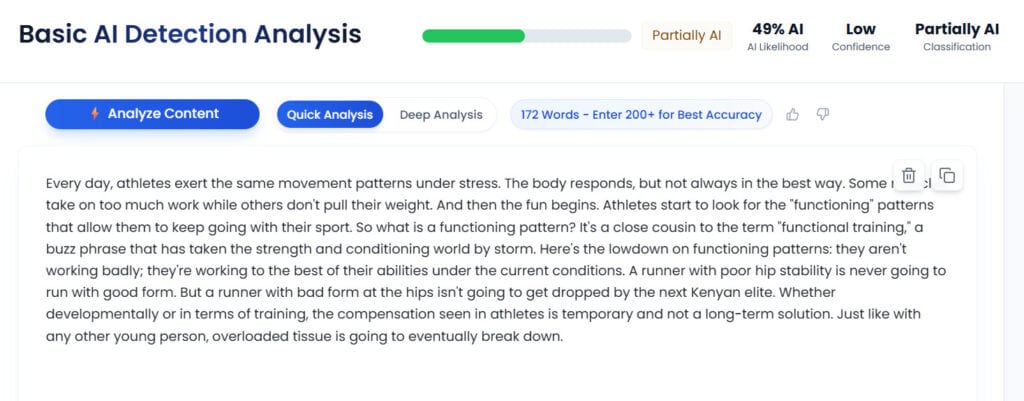
Test 3: Gemini Essay, Humanized by Undetectable AI
Verdict: Flagged the text as likely AI-Generated
AI Likelihood Score: 73%
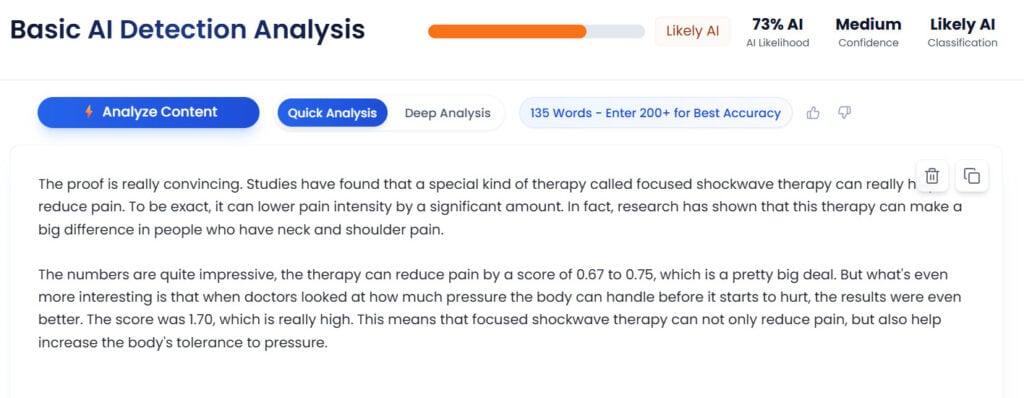
Test 4: Gemini Essay, Humanized by Twixify
Verdict: Identified the text as likely Human Written Score
AI Likelihood Score: 49%

Test 5: Claude Essay, Humanized by Undetectable AI
Verdict: Flagged the text as likely AI-Generated
AI Likelihood Score: 66%

Test 6: Claude Essay, Humanized by Twixify
Verdict: Flagged the text as likely AI-Generated
AI Likelihood Score: 46%

The Score at a Glance
| Test | Source Model | Humanizer | Score | Passed Detection? |
| #1 | ChatGPT | Undetectable AI | 41% | No |
| #2 | ChatGPT | Twixify | 49% | No |
| #3 | Gemini | Undetectable AI | 73% | No |
| #4 | Gemini | Twixify | 19% | Yes |
| #5 | Claude | Undetectable AI | 66% | No |
| #6 | Claude | Twixify | 46% | No |
| Avg | Undetectable AI | 60% | 0/3 | |
| Avg | Twixify | 38% | 1/3 |
My Final Thoughts
To be honest, neither tool performed perfectly, and it's worth mentioning that right away.
If you're looking for a humanizer that can make something completely undetectable, you're likely to be let down by what we found.
Twixify had an average AI likelihood score of 38% across three tests. What's more, it was the only tool that managed to produce a result that TruthScan thought was written by a human.
On the other hand, Undetectable AI had a much higher score of 60% and was flagged as AI-written or (partially) on all three tests.
This big gap is hard to ignore. So, let's put the Undetectable AI numbers into perspective.
We were using the Basic Public Model, the more advanced humanization models are only available with paid plans, and there's a noticeable difference in performance between the different tiers.
If you’re looking at how well each tool can make text sound like it was written by a human, Twixify does a better job. However, that's not the only thing to consider.
Undetectable AI has built in AI detectors that can also see if a piece of text or an image was created by a human or not, and you get this feature along with the humanization tool when you subscribe.
Twixify, on the other hand, is a standalone humanization tool and doesn't offer anything else. So keep that in mind.
For the basics behind the test, see how to check if something was written with AI.
Want to Learn Even More?
If you enjoyed this article, subscribe to our free newsletter where we share tips & tricks on how to use tech & AI to grow and optimize your business, career, and life.